The Complete Guide to Advertising and Marketing for Schools, Kindergartens, Coaching Centres, and Universities

Updated: Jul 4
Quick answer: Education-sector advertising in India is almost entirely admissions-driven, which means most institutions market intensely for a few months a year and go silent the rest of the time. A more effective approach maintains a consistent, trust-building presence year-round rather than concentrating all marketing into the admissions window.
If you run a kindergarten, manage admissions for a CBSE or ICSE school, own a coaching institute preparing students for JEE, NEET, or board exams, or handle marketing for a university or professional college — you already know something that most marketing agencies will not say out loud.
Education marketing is fundamentally different from every other category of advertising. The decision being made is not about a meal or a pair of shoes. It is about a child's future, a family's biggest financial commitment, and a trust relationship that needs to be built before a single rupee changes hands.
And yet most schools, coaching centres, and universities are still marketing themselves the exact same way a food delivery app or a fashion brand would — interruption-based digital ads, scattered offline hoardings, and pamphlets handed out at traffic signals.
This piece is going to walk through exactly why that approach is failing education brands specifically, what the real numbers say about current advertising costs in this sector, and why a fundamentally different and more precise approach — one built around genuine trust and targeted physical presence — is the better path forward for every institution from a neighbourhood kindergarten to a national university.
Let see what are the best advertising and marketing for schools and coachings
The Indian Education Market — The Scale Behind Every Admission Decision and The Best Advertising and Marketing For Schools and Coachings

Before addressing what is broken, it helps to understand the genuine scale of the opportunity every education institution is operating inside.
The India school market reached USD 59.67 billion in 2025 and is projected to reach USD 138.33 billion by 2034, growing at a CAGR of 9.79%. India holds an extraordinary position in global education, with around 1.55 million K-12 schools operating across the country.
The India coaching institutes market reached USD 7.2 billion in 2025 and is projected to reach USD 17.8 billion by 2034, growing at a CAGR of 10.29%. This explosive growth is driven by intense competition for exams like JEE, NEET, UPSC, and CAT, where limited seats in prestigious institutions push millions of students toward structured coaching every single year.
The India higher education market was valued at INR 6.2 trillion in 2025 and is expected to reach INR 12.7 trillion by 2034, driven by rising enrolment, NEP 2020 reforms, and growing demand for skilled graduates.
This is not a small or niche sector. It is one of the largest, most emotionally significant, and most consistently growing consumer markets in India — and unlike many categories, demand in education does not disappear during economic downturns. Parents will cut back on almost everything before they cut back on their child's education.
The opportunity is enormous. The question is whether your current advertising approach is actually reaching the parents and students who are making these decisions.
Why Digital Advertising Is Failing Education Institutions

Digital advertising has become the default channel for most education marketing in India — and on paper, it looks effective. But the honest numbers tell a more complicated story.
Meta Ads for schools have become the most reliable paid channel for driving admission inquiries, allowing schools to reach the exact parents who are actively searching for quality education — and convert them into inquiries at a cost that traditional advertising allegedly cannot match.
That claim deserves scrutiny, because the real picture is more nuanced.
The cost-per-lead problem compounds at every admission season. Education marketers are advised to measure ROI using Cost Per Lead and Cost Per Admission rather than vanity impressions or clicks — because in a highly competitive education market, marketing spend has to be viewed as a direct investment linked to admission outcomes, not a fixed cost.
The challenge is that every school in your city is bidding on the same keywords and the same parent audience at the same time, during the same compressed admission season window. This is fundamentally different from most consumer categories, where demand is spread across the year. Schools and coaching centres are all fighting for the same parents during February to June admission season, which drives costs up sharply during exactly the period when institutions need results most.
The targeting problem is structural, not fixable. A "parents with children aged 3 to 5" interest segment on Meta does not tell you whether that parent has the financial capacity for your fee structure, whether they live within a realistic commuting distance of your campus, or whether they share your institution's educational philosophy. You are paying to reach an approximate demographic, not a verified, relevant prospect.
The regulatory and trust dimension makes this worse for education specifically. Digital marketing in the education sector requires a higher standard of responsibility than most other industries, because parents are making long-term decisions about their child's future. Exaggerated promises, unsubstantiated rankings, or misleading fee and admission claims can lead to ad disapprovals, account suspensions, and long-term damage to digital visibility — and parents themselves are increasingly skeptical of polished digital advertising claims about academic outcomes that cannot be independently verified through a scrolling ad.
The seasonal cliff is brutal for budget planning. Admission marketing concentrates almost entirely into a few months each year. Outside of that window, ad spend efficiency collapses because there are simply fewer parents actively searching — yet schools that go completely silent during off-season lose the compounding brand familiarity that makes the next admission season's campaigns more efficient.
The fundamental issue is this: digital advertising for education tries to convert a parent's life-defining decision using the same interruption-based mechanics used to sell a food delivery coupon. The mechanics do not match the gravity of the decision — and increasingly sophisticated parents notice the mismatch.
Why Offline Advertising Is Even Worse for Education Institutions

When digital advertising results disappoint, many schools and coaching centres fall back on traditional offline advertising — hoardings, pamphlets, newspaper inserts, auto-rickshaw branding. The problems here are arguably even more pronounced for education specifically.
Hoardings — Reaching Everyone Except the Decision-Maker
A hoarding for your school placed on a busy city road reaches thousands of commuters daily. The overwhelming majority of them are not parents currently evaluating schools. They are office workers, delivery riders, shop owners, retirees — people for whom your message has zero relevance at that exact moment.
Even among the small fraction who are parents, you have no way of knowing whether their children are the right age for your institution, whether your fee structure matches their budget, or whether they are even considering a change of school this year.
For coaching institutes specifically, hoardings advertising "99% selection rate" or similar claims face a deeper credibility problem — sophisticated parents and students researching JEE or NEET coaching have learned to be skeptical of unverifiable hoarding claims, and increasingly look for specific, verifiable outcomes instead.
Pamphlets — The Worst Possible Format for a Trust-Based Decision

Imagine a pamphlet for your kindergarten or coaching centre being handed to someone walking past a busy intersection.
The person receiving it may not even be a parent. If they are, they are in transit — managing traffic, their phone, their bags — not in any frame of mind to evaluate a decision that will shape their child's education for years.
The pamphlet gets folded, pocketed, and forgotten. Education decisions — among the most researched, most discussed, most carefully weighed decisions any parent makes — are never won through a piece of paper handed out at a traffic signal.
Worse, the act of mass-distributing pamphlets sends a quality signal that works directly against what most education institutions are trying to communicate: care, individual attention, and considered investment in each child's future.
Newspaper Inserts — Declining Reach, High Cost, Wrong Audience Mix
Newspaper readership in India skews toward older demographics in many markets, and inserts reach every reader of that publication regardless of whether they have school-aged children, are evaluating coaching options, or are anywhere near your relevant admission window.
For a coaching institute or university running a costly full-page newspaper announcement, the actual percentage of readers who are realistic prospects — parents of students at the right academic stage, in the right geographic catchment, with the right financial profile — is a small fraction of the total readership being paid for.
The Environmental and Values Mismatch
Schools, in particular, are increasingly expected to model the values they teach. An institution that talks to students about environmental responsibility, sustainability, and conscious citizenship while distributing thousands of single-use vinyl banners and printed pamphlets for its own admission campaigns is sending parents — many of whom are themselves environmentally conscious — a subtly contradictory signal.
What Actually Drives Education Decisions — The Psychology Every Institution Needs to Understand

Here is the insight that should reshape how every school, coaching centre, and university thinks about marketing.
Education decisions are almost never made from a single advertisement. They are built through repeated trust-building exposure over an extended period, reinforced by:
Word of mouth and peer recommendation. Parents trust other parents whose children attend a school far more than they trust any institution's own marketing claims. A strong brand reduces cost per lead and improves conversion rates precisely because trust, once established, compounds.
Local presence and familiarity. Parents trust institutions that appear repeatedly and consistently within their community — not because of advertising frequency, but because consistent, positive, low-pressure presence builds the comfort that a major decision requires.
Top of mind awareness at the exact moment of need. When a family starts seriously considering kindergarten options, or when a student begins evaluating coaching institutes for the next academic cycle, the institutions that come to mind first are the ones already familiar through repeated, low-pressure encounters — not the ones competing hardest for ad auction placement during peak season.
This is precisely why genuinely useful, repeatedly-encountered brand presence works fundamentally differently — and more effectively — than advertising that interrupts.
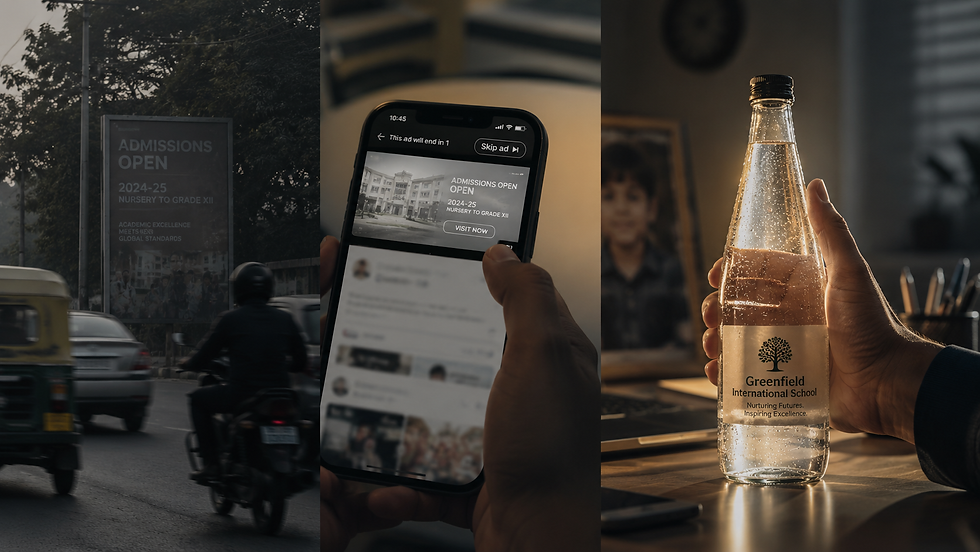
A premium glass bottle carrying your school, coaching institute, or university's identity, placed in the hands of the right parent or student, in the right community environment, every single day for months, builds exactly this kind of quiet, trusted familiarity. Not through a sales message. Through consistent, positive, ordinary presence in daily life.
How Hydrobillboard Works for Education Institutions — Precisely Targeted, Not Approximately Targeted
Hydrobillboard places premium branded glass bottles into the hands of the exact parents, students, and decision-makers who are most relevant to your institution — in the environments where they actually spend their time.
Here is what that looks like across different types of educational institutions.
If You Run a Kindergarten or Preschool

Your decision-maker is a parent of a child aged 2 to 5, almost always within a tight geographic radius of your campus, because very few parents will commute long distances for early childhood education.
Hydrobillboard places your branded bottles precisely with:
Parents at paediatric clinics and child health centres in your catchment area
Mother and parent communities, kitty parties, and parenting groups within realistic commuting distance
Residential societies and apartment complexes specifically within your enrolment radius
Children's activity centres — art classes, music schools, swimming classes — frequented by families with young children
Every bottle reaches a parent who is geographically realistic, demographically relevant, and already engaged in decisions about their young child's development and care.
If You Run a CBSE, ICSE, or State Board School
Your audience spans Primary through Senior Secondary parents — a broader age range, but still anchored by geography and a desire for consistent, trustworthy local presence.
Hydrobillboard places your branded bottles with:
Corporate offices in your catchment area where working parents — increasingly the decision-makers in dual-income urban households — spend their days
Premium co-working spaces in your school's neighbourhood
Sports academies, music schools, and extracurricular centres where school-aged children and their parents are already present
Community centres and residential clubhouses within your enrolment zone
A parent who picks up your school's branded bottle every morning at their office desk, or sees it consistently at their child's weekend cricket academy, builds a comfort and familiarity with your institution's name that no banner ad or hoarding glimpsed once can replicate.
If You Run a Coaching Institute — JEE, NEET, UPSC, Board Exam, or Skill-Based

Your audience is highly specific: students at a particular academic stage, often accompanied by parents who are co-decision-makers and co-payers.
Hydrobillboard places your branded bottles precisely with:
School campuses where students at the relevant grade level — Class 9 through 12 for JEE/NEET coaching, graduates for UPSC and CAT coaching — actually study
College and university libraries and study spaces where competitive exam aspirants spend hours daily
Other coaching centres' adjacent ecosystems, where students moving between subjects or preparing for multiple exams are already present
Parent professional networks and offices, reaching the co-decision-maker directly
This is precision that no digital platform can replicate. If your coaching institute specifically targets NEET aspirants, every bottle goes to a student actually preparing for NEET — not a broad "students" interest category that includes people with no connection to competitive medical entrance exams.
If You Run a University, Degree College, or Professional Institution
Your audience includes prospective students researching options months or years in advance, as well as parents who remain influential co-decision-makers even at the undergraduate and postgraduate level.
Hydrobillboard places your branded bottles with:
Senior secondary schools and Class 12 student communities in your target enrolment regions
Coaching institutes whose students are natural pipeline candidates for your specific programmes
Career counselling centres and education consultancies
Corporate offices where working professionals considering executive education, MBA programmes, or part-time degrees are concentrated
For a university running a campaign timed to a specific admission cycle, this kind of precise placement reaches exactly the students at the exact academic stage where your institution becomes relevant — months before competitors relying purely on digital search bidding even enter the consideration set.
Why Hydrobillboard Is Exceptional for Admission Openings, Course Launches, and Registration Announcements

There is a specific use case where Hydrobillboard performs exceptionally well for educational institutions — and it deserves particular attention: time-bound announcements like admission openings, new course launches, and registration deadlines.
Most institutions handle these moments with a burst of digital ad spend and a flurry of social media posts — competing against every other institution doing the exact same thing during the exact same compressed window, driving costs up precisely when budgets are already stretched.
Hydrobillboard offers a fundamentally different mechanism for these moments:
Pre-positioned awareness. Because Hydrobillboard bottles are already in daily use among your precisely targeted audience months before an admission window opens, your institution's name is already familiar when the announcement happens. You are not trying to build awareness and convert in the same compressed window — awareness is already established.
Campaign content amplification. Hydrobillboard creates and publishes campaign reels and social content specifically tied to your admission opening or course launch — extending the announcement's reach across digital channels without requiring you to separately manage a paid social campaign during your busiest operational period.
A physical reminder that does not get lost in a crowded feed. A parent who already has your branded bottle on their desk sees a tangible, daily reminder of your institution's name during exactly the weeks when they are also seeing dozens of competing digital ads from other institutions. Your brand has a presence beyond the feed — sitting on their desk, at their child's after-school class, in their hand at the office.
No bidding war against every other institution launching at the same time. While every competing school or coaching centre bids against each other for the same parent audience on Google and Meta during peak admission season — driving CPL up sharply — your Hydrobillboard campaign continues generating impressions at zero additional cost, because the bottles are already distributed and already in daily use.
For a coaching institute announcing a new batch, a university opening applications, or a school announcing admission dates — this combination of pre-existing familiarity plus targeted digital amplification is a structurally different and more efficient path to filling seats than competing in the same overcrowded digital auction every other institution is fighting in simultaneously.
Why Eco-Friendly Marketing Produces Measurably Better Results for Education Brands Specifically

This is a dimension unique to education marketing that deserves direct attention.
Schools, coaching institutes, and universities are not just selling a service. They are positioned — explicitly or implicitly — as institutions that shape values, character, and the next generation's relationship with the world. Parents evaluating a school are not only assessing academic outcomes. They are assessing what kind of institution they want shaping their child.
46% of consumers feel more favourable about brands that offer eco-friendly products — and this sentiment is measurably stronger among parents making decisions on behalf of children, who are increasingly raising their own kids with environmental consciousness as an explicit value.
A premium glass bottle — reusable, sustainable, free of the single-use plastic waste that pamphlets, vinyl banners, and disposable promotional material represent — is not just a marketing vehicle for an educational institution. It is a direct demonstration of the values the institution claims to teach.
When a school's admission marketing arrives via single-use plastic-laminated pamphlets, it sends a quiet contradiction to environmentally conscious parents. When it arrives via a premium glass bottle that becomes part of someone's daily life, it reinforces exactly the values the institution wants to be known for.
This alignment between medium and message is uniquely powerful in education — more so than in almost any other advertising category — because parents are not just evaluating a product. They are evaluating an institution's character.
The Comparison Every Education Institution Needs to See
Factor | Digital Advertising | Offline Hoardings and Pamphlets | Hydrobillboard |
Reaches relevant parents/students specifically | ⚠️ Demographic targeting approximate | ❌ Reaches everyone in the area | ✅ Placed precisely in environments matching your exact target audience |
Cost during peak admission season | ❌ Spikes sharply — all institutions bidding simultaneously | Untrackable but typically high relative to reach | One-time campaign cost — unaffected by seasonal bidding wars |
Builds pre-admission-season familiarity | ❌ Mostly active only during admission window | ❌ Sporadic, inconsistent | ✅ Daily presence builds awareness months ahead of decision point |
Communicates institutional values | ⚠️ Depends entirely on ad creative | ❌ Single-use materials contradict sustainability messaging | ✅ Reusable glass directly demonstrates the values being taught |
Trust-building mechanism | ❌ Interruption — parents increasingly skeptical | ❌ Mass, impersonal, low credibility | ✅ Repeated positive daily presence — builds trust organically |
Suitable for time-bound admission announcements | ⚠️ Effective but expensive and crowded | ⚠️ Slow to deploy, easily ignored | ✅ Pre-positioned awareness plus digital content amplification |
Reaches the actual co-decision-maker (working parents) | ⚠️ Approximate targeting | ❌ No targeting capability | ✅ Placed directly in corporate offices and professional environments |
Impressions after campaign budget ends | ❌ Zero | ❌ Zero | ✅ Continues for months per bottle |
The Bottom Line for Every Education Institution

Whether you run a single-classroom kindergarten, a CBSE school with a thousand students, a coaching institute preparing the next generation of doctors and engineers, or a university shaping young professionals — the marketing challenge you face is fundamentally about trust, precision, and timing.
Digital advertising reaches an approximate demographic at a cost that spikes precisely when you need results most.
Offline hoardings and pamphlets reach everyone except the parent who is actually deciding.
Hydrobillboard reaches the exact parent, the exact student, the exact community member who is relevant to your institution — and builds the kind of quiet, repeated, trust-reinforcing familiarity that education decisions actually depend on.
If your kindergarten needs to reach parents within your enrolment radius — every bottle goes to a parent in your catchment area.
If your coaching institute needs to reach NEET aspirants — every bottle goes to a student actually preparing for NEET.
If your university needs to reach Class 12 students considering their next step — every bottle goes to the schools and communities where those exact students are present.
Daily. Physical. Precisely targeted. Building trust quietly, long before the admission window opens — and continuing to reinforce it long after.
That is not advertising in the traditional sense. It is the kind of consistent, values-aligned, trust-building presence that the most important decisions families make actually require.
For education institutions — where every admission represents a family's trust in your hands for years to come — that one percent of marketing done with genuine intention is worth more than any banner that gets glanced at once and forgotten.
FAQ block:
Why is education advertising in India concentrated into a short window? Because most institutions treat marketing as an admissions-season activity rather than a year-round trust-building effort.
What advertising works best for schools and coaching centres? Advertising that builds consistent, visible trust with parents and students throughout the year tends to perform better than a short, high-intensity admissions push.
Does digital advertising work well for schools and coaching centres? Digital ads can build awareness, but parents typically make enrollment decisions based on trust and reputation, which digital ads alone struggle to establish.
How can a coaching centre or school stand out locally? By maintaining visible, consistent brand presence within the local community rather than relying solely on seasonal digital campaigns.