Hydrobillboard. The Bottle That Refused To Be Just A Bottle.

Quick answer: Hydrobillboard is India's first glass bottle based ambient media company. A branded glass water bottle is placed in hotels, gyms, weddings, offices, and cafes, where a person holds it, drinks from it, and sits with it for as long as they are thirsty. Every placement is documented by Hydrobillboard Studio, the in house film and photo production arm, which also runs an AI Studio for AI generated visuals and AI music. A separate page, Hydrobillboard Designs, features the actors, models, and designers who appear in that work and also concepts created by artists.
I want to be honest with you before we even get into this. I did not write this blog to sound like a brochure. I wrote it because most people, even the ones running marketing budgets, still do not fully understand what Hydrobillboard is doing, and once you actually get it, it is hard to unsee. This is a longer read, but by the end you will know exactly what this is, who it is for, and where to see the work.

Why advertising feels broken right now
Digital advertising still works, for some people, in some categories. But if you have run a reel campaign lately, you already know the truth. People scroll past things in under a second, they mute videos before the first word is spoken, and a meaningful share of the internet now browses with an ad blocker turned on without even thinking about it. In India specifically, roughly half of internet users report using an ad blocking tool, one of the higher rates anywhere in the world, and globally the number of people blocking ads has been estimated at close to 1.8 billion as of mid-2025.((SEO Sandwitch: Latest Ad Blocking Statistics for 2025, citing Statista and PageFair, https://seosandwitch.com/new-ad-blocking-stats/)) ((Backlinko: Ad Blocker Usage and Demographic Statistics in 2026, citing GWI, https://backlinko.com/ad-blockers-users))
Attention itself has been shrinking for two decades. Research out of UC Irvine tracking how long people stay focused on a single screen before switching found the average dropped from about two and a half minutes in 2004 to roughly 47 seconds by the late 2010s, a decline researchers describe as a genuine shift in attentional habits rather than a temporary dip.((National Geographic: The average attention span has shrunk to roughly 40 seconds, citing Dr. Gloria Mark, UC Irvine, https://www.nationalgeographic.com/health/article/attention-spans-shrinking-how-to-regain))
Traditional advertising did not age any better. A hoarding on a highway gets glanced at for two or three seconds by someone doing eighty kilometres an hour, if they look up from the road at all. A newspaper ad gets read once, maybe, and by evening it is wrapping something in the kitchen. These formats were built for a time when attention was cheap. That time is gone, and everyone is fighting over the same shrinking pool of it.
So where does a brand actually go from here. Not louder digital, because louder digital just means more competition inside the same crowded, ad blocked feed. Not bigger traditional, because bigger traditional just means more money for the same fleeting glance. The answer Hydrobillboard is built around is to stop fighting for attention and instead attach the brand to something people are already doing anyway.
What is Hydrobillboard, really

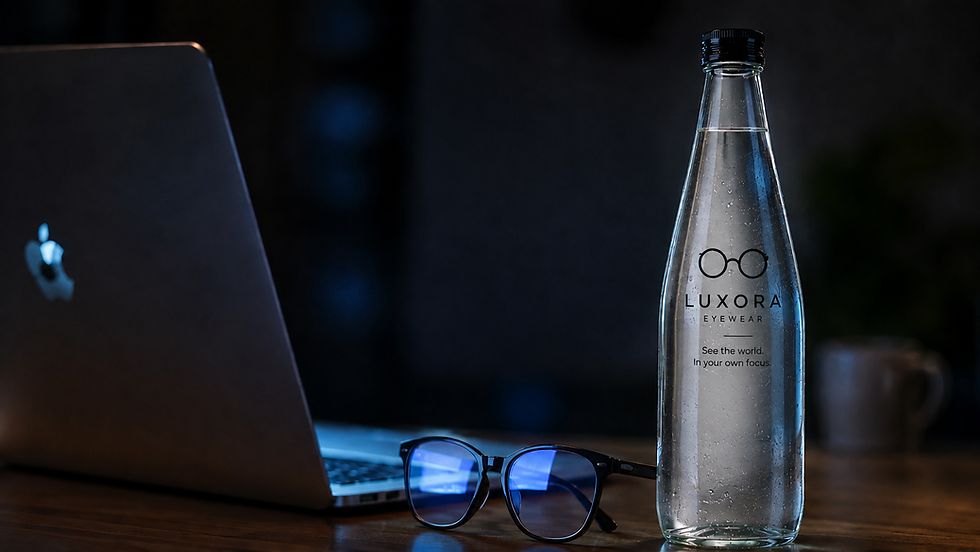
People drink water. All day, every day, everywhere, regardless of income, city, or occasion. It is one of the only truly universal human behaviours left that has not been fully claimed by advertising. Hydrobillboard takes that behaviour and puts a brand on it, using premium glass bottles rather than the cheap plastic wrap most people picture when they hear "bottle branding." Glass changes the psychology of the object. A plastic bottle with a sticker on it feels like a giveaway, something drunk once and tossed. A glass bottle feels like something worth keeping on the table, worth photographing, worth being seen holding.
That single material choice also tracks where the market itself is heading. India's premium bottled water segment was valued at roughly USD 1.27 billion in 2025 and is projected to nearly double by 2034, with glass packaging already holding the largest share of the premium segment and continuing to grow as eco-conscious, plastic-free preferences spread through hotels, gyms, and travel.((IMARC Group: Premium Bottled Water Market in India, https://www.imarcgroup.com/india-premium-bottled-water-market)) ((GM Insights: Premium Bottled Water Market Size, Forecasts Report 2026-2035, https://www.gminsights.com/industry-analysis/premium-bottled-water-market))
When a Hydrobillboard bottle shows up in a hotel room, a wedding reception, a gym, or a corporate office, it is not competing with anything. Nobody is trying to skip past it or mute it. It just sits there, being used the way a bottle is normally used, except now every person who picks it up is looking directly at the brand for the entire time they hold it. There is no skip button on a bottle in your hand.
The line the brand runs with sums it up: Your brand in every hand.
Why the physical side is not a gimmick
People hear bottle advertising and assume it is small, cute, low impact. It is not, once you look at where these bottles end up and how long people spend with them. A hotel guest keeps that bottle in their room for the length of their stay, sometimes multiple days. A gym member holds it through an entire workout, sets it down, picks it back up, over and over. A wedding guest sits with it on the table for hours, through speeches, through dinner, through dancing, and ends up in frame with it in every casual photo from the night, without either of them meaning to advertise anything.
There is a line the brand uses internally and publicly that captures this: One bottle. One brand. One percent. Even a modest campaign moves the needle disproportionately to the spend, because physical presence compounds differently than a digital impression does. A digital ad exists for the length of a scroll and disappears the second the app closes. A bottle sits, physically, in a room, for hours, sometimes days, getting looked at repeatedly by the same person and by everyone who walks past them.
The pricing structure reflects the same thinking. It is budget tiered, not package based. A business comes in with whatever it can actually spend, starting from a genuinely low floor, and the bottle count is calculated against that budget rather than forcing anyone into a slab that does not fit their size. That is a founder level decision, made by someone who has sat across the table from small business owners and understood what it feels like to be quoted a number that has nothing to do with what they can afford.
Hydrobillboard Studio: the production arm most companies skip
A lot of physical advertising businesses stop at the placement. They hand over the product, wish the client luck, and disappear until renewal. That is not what happens here, because a physical campaign without digital proof only tells half the story in a world where everyone still wants something to post, something that proves the campaign actually happened and actually looked good.
Every partnership, no matter the size or budget tier, comes with Hydrobillboard Studio bundled in. Not as an upsell to negotiate for, not as a paid extra tacked onto an invoice, but as something baked into what the product fundamentally is. Studio is the video and photo production side of the business, documenting the campaign with cinematic reels, real product style photography, and on ground content shot the way you would shoot a short film, not a stock catalogue image.
That means a brand does not just get a logo on a bottle in a hotel lobby. It gets a reel of that exact moment, shot well enough to post, good enough to send to investors or clients as proof the campaign happened and happened properly. The physical placement turns into digital content automatically, without the brand hiring a separate videographer or figuring out how to make a water bottle look interesting on camera. That loop, physical campaign becoming ready to use digital proof, is something most ambient and outdoor advertising companies in India have simply never bothered to close. Hydrobillboard closes it by default, every time. For brands that want an upgraded production tier with more services layered on, that sits under Studio Plus.
AI Studio: photos, video, 3D, and now music
Sitting alongside the human led Studio work is AI Studio, run by a small in house team that stays current on whatever the latest AI models can actually do. It covers AI generated brand and product photography, AI built reels and cinematic video for situations too expensive or complicated to shoot conventionally, three dimensional marketing product videos, and AI generated music for campaigns and reels that need an original score or track rather than a licensed one.
AI Studio is not positioned as a cheaper substitute competing against the human led Studio. It sits next to it, so a brand can choose a regular Studio shoot, go the AI route, or blend both depending on what a specific campaign calls for. The team's creative process runs on top tier video editing software and large language models, and the AI photo, video, and music samples already produced are ready to show on the Studio page itself.
Hydrobillboard Designs: where the people behind the work and their concept get featured
Sitting apart from Products and Industries in the site's navigation is Hydrobillboard Designs.
Where creativity finds its cover.
This is not a portfolio grid of bottle shots. It is closer to a rotating features section, an in house magazine cover, spotlighting the actors, models, and designers,concepts, anyone who brings art, creativity, and nature into the work Hydrobillboard produces. Each feature reads the way an actual magazine cover would, moody studio lighting, a confident pose, the wordmark sitting behind the subject rather than boxed on top of them.
Two pieces already live in that world give a sense of the range: Mark, a Hindi rap video, and Dissolve, an English rap video, both produced through Hydrobillboard's own film and creative process rather than treated as side projects.
Designs also goes beyond finished films and features. It is where the unimaginary lives, the surreal, imaginative concepts, photo styles, and ideas built by various artists who work with Hydrobillboard, the shots that would not fit under Product or Industries because they were never meant to sell a bottle in the first place. They exist because someone had an idea worth building, and the page gives that idea a real place to be seen.
If you want a quick preview of what this actually looks like before reading any further, the fastest way is Hydrobillboard on Instagram, where "Mark" and "Dissolve" are both up, or the Design section of the website directly.
Talking about the art of it
A lot of people hear bottle advertising and picture a cheap sticker slapped onto plastic packaging. That is what most bottle branding in India has looked like for years. That is not what is happening here, and it is worth explaining why, because there is genuine design thinking behind how a bottle wrap gets built, not far off from the thinking that goes into a painting hanging in a gallery.
Take the Mona Lisa. Da Vinci did not paint her looking directly outward by accident. The angle of her face, the softness of the shadows around her eyes, the way she seems to watch a viewer no matter where they stand in the room, all of it was engineered, deliberately, to hold attention longer than a passing glance. A brand printed on a Hydrobillboard bottle works from a similar principle in a completely different medium. It is composition, colour, typography, and placement, thought through so the eye lands on it and stays there while someone sits with a drink for twenty minutes at a wedding table, rather than glancing once and forgetting it existed.
Or think about Picasso, who took a human face and broke it apart into geometric shapes, and counterintuitively made the work more memorable rather than less, because bold, unexpected form gets remembered while safe, predictable form gets ignored. That is really the argument for ambient media over another forgettable static hoarding on the side of a road. A branded bottle sitting on a dinner table is an unexpected format for an advertisement, it breaks the pattern the way cubism broke the pattern of realistic portraiture, and that break is precisely why it gets noticed and remembered afterward instead of blending into the background.
This is also why the cinematic reels coming out of Hydrobillboard Studio, and the features going up on Hydrobillboard Designs, matter as much as they do. They are not treated as documentation of a business transaction, they are treated more like short film work, with real people, thoughtful framing, and something resembling a narrative arc, because a bottle photographed like a flat catalogue image gets scrolled past in half a second, while a bottle shot like a scene from a film actually gets watched to the end.
Going city by city, because this matters more than people think
Hydrobillboard is built around pan India reach, and the mechanics of the model genuinely do not change whether it is running in a metro or a smaller city. India's outdoor advertising market itself was valued at roughly USD 1.42 billion in 2025 and is projected to keep growing through 2034, which is the pool this model is competing inside of, without needing metro level billboard budgets to do it.((IMARC Group: India Outdoor Advertising Market Size, Share, https://www.imarcgroup.com/india-outdoor-advertising-market))
Take Delhi first. Out of home advertising rates in Delhi are among the highest in the country, and a hoarding on the Delhi Gurgaon expressway costs a serious amount of money for two seconds of glance from someone doing eighty kilometres an hour. Compare that to a bottle placed in a corporate office in Gurgaon or a wedding venue in South Delhi, where the same brand in every hand effect plays out for a fraction of the cost, over hours instead of seconds.
Move to Mumbai, and the story is similar for different reasons. Every square foot of visible advertising space in the city is fought over by real estate developers and film promotions, and getting noticed through a traditional billboard means outspending people with genuinely enormous budgets. A glass bottle in a five star hotel lobby, or a fitness studio in Bandra, does not need to outspend anyone. It just needs to exist where people are already spending time.
Bengaluru works differently because of what the city is, a tech and startup hub full of corporate offices and co-working spaces, exactly the kind of environment where high dwell time matters more than raw footfall. A branded bottle sitting on a desk all day does more quiet brand recall than a month of LinkedIn ads.
Hyderabad, Chennai, Pune, Kolkata, Ahmedabad, and Jaipur all follow the same underlying logic, because hotels, gyms, wedding halls, and corporate parks exist in every one of these cities in some form, and the model simply plugs into infrastructure that is already there rather than trying to build new billboard real estate from scratch.
And then there is Bihar, specifically Madhubani, where Hydrobillboard is actually headquartered and legally registered. This was not a compromise or a default from limited options. It was a deliberate, cost conscious founder decision, because running the business lean out of a smaller city keeps the entire cost structure healthy, which is exactly why pricing can stay accessible for brands instead of getting inflated the way it usually does when a company sits in a metro paying metro level rent. Tier two and tier three markets across India, often called Bharat markets in advertising circles, are becoming a genuinely important part of the out of home industry, and being based inside one of these markets rather than occasionally serving one from a distant metro gives a level of understanding that a Delhi or Mumbai headquartered ambient media company simply does not have.
Why this ends up fitting almost anyone who tries it
A hotel wants guests to remember the brand after checkout, not just during the stay. A wedding planner wants a sponsor visible without cluttering the decor they worked hard on. A gym wants a partnership that does not feel like a random logo pasted onto a wall nobody looks at twice.
A cosmetics brand, a real estate developer, a fintech startup, a local restaurant chain, none of these businesses are a natural fit for a highway billboard, and most cannot justify the cost of one either, but every one of them fits naturally onto a bottle sitting on a table, because every one of their customers drinks water at some point during the interaction.
Digital advertising needs precise targeting to avoid feeling wasted, and even then it often misses. Traditional billboards need massive scale and massive budgets to justify their cost per glance. A branded bottle needs neither. It just needs a place where people sit down, drink, and stay for a while, and that kind of place exists in every city, every industry, and every budget bracket, starting from a genuinely low entry point and scaling up from there.
Where to see the work
Nothing in this blog is going to convince anyone as well as the work itself does. For a quick preview:
Instagram for reels and behind the scenes, including "Mark" and "Dissolve"
Hydrobillboard Design on the website for the full set of features
Pinterest and Behance for Product and Industries concept photography
YouTube for longer cuts of the reels and Studio work
LinkedIn and X for founder-voice updates and partnership announcements
The honest, no spin bottom line
Advertising in this decade is not short of channels. What it is short of is attention, real attention, the kind that sticks with someone for longer than a second, in a country where roughly half of internet users are already blocking ads and average screen attention has fallen to under a minute. What actually moves the needle now is presence that feels human, physical, and genuinely hard to ignore, paired with content that proves it happened rather than just claiming it did.
Hydrobillboard sits in that gap. Physical placement nobody can skip past, paired with a production arm, human and AI, that turns every placement into content worth sharing, a Design page that puts real creative people in front of the brand, and a lean operating base that keeps the whole thing genuinely affordable. That is not a gimmick. It is what advertising starts to look like once someone actually thinks carefully about where people's eyes go, instead of buying whatever ad space happens to be cheapest that month.
FAQ
Is Hydrobillboard only for big brands with big budgets? No. Pricing is budget tiered rather than locked into fixed packages, so a brand can start small with whatever it actually has to spend and scale the campaign up from there.
Does Hydrobillboard only work in metro cities? No. The model works anywhere there are hotels, gyms, wedding venues, or corporate offices, which means it works across metros and tier two cities alike.
What is Hydrobillboard Studio? The built-in video and photo production arm that comes free with every partnership, turning each physical bottle placement into a cinematic reel and a set of usable photos.
What is AI Studio? The AI layer inside Studio, covering AI generated product photography, AI built reels and cinematic video, 3D marketing product videos, and AI generated music, run by a team that tracks the latest AI models. It sits alongside human led Studio work rather than replacing it.
What is Hydrobillboard Designs? A style page featuring the actors, models, and designers connected to Hydrobillboard's creative work, styled like a magazine cover rather than a standard portfolio page. It also features surreal and imaginative concepts, photo styles, and ideas built by various artists, work that exists for its own sake rather than to sell a specific bottle.
Why glass instead of plastic? Glass reads as premium, photographs far better, and does not carry the disposable, cheap giveaway feeling that plastic bottle branding almost always has, which also lines up with where India's premium bottled water market is already heading.
Where can I see actual examples of the work? The Hydrobillboard Instagram page, the Design section of the website, and the gallery, Pinterest, and Behance for concept photography.