Eyewear and Glasses Advertising in India

Quick answer, eyewear advertising in India is fighting a genuinely unusual problem. This industry can't demonstrate its actual product, how a frame sits on a specific face, how comfortable it feels after eight hours, through a screen, and its fastest growing customer segment, children with rising myopia rates, is being told by doctors to spend less time on exactly the channels most eyewear marketing depends on. What actually reaches this buyer is real, physical, repeated presence, in the outdoor spaces doctors are now actively encouraging people to spend more time in, which happens to be precisely where Hydrobillboard operates.
In May 2026, during World Myopia Week, the All India Ophthalmological Society released a set of national guidelines with a very specific instruction in them: children should spend a minimum of two hours outdoors every day, and everyone, adults included, should follow the twenty twenty twenty rule, a twenty second break every twenty minutes, spent looking at something twenty feet away. Away from the screen. Every screen.
Read that guideline again, and then think about where most eyewear advertising in India actually lives. Instagram. YouTube pre-roll. Google display ads. Exactly the screens the country's own ophthalmologists are asking people to look away from more often. An industry that exists because of what screens are doing to people's eyes is, for the most part, still trying to reach those same people through more screen time.
That's not a criticism of any single brand. It's just an odd, slightly uncomfortable fact worth sitting with before spending another quarter's budget the same way everyone else does.
A market growing faster than most people realise

India's eyewear market was valued at roughly 6,600 million dollars in 2024 and is projected to keep growing at close to 12% a year through the rest of the decade. Prescription glasses remain the single largest product category, driven by a genuinely alarming rise in vision problems, but sunglasses and fashion eyewear are growing quickly too, as frames shift from purely functional to something people actually choose the way they'd choose any other accessory.
One company has reshaped the category almost entirely on its own. Lenskart expanded from under two thousand stores to over twenty seven hundred between FY23 and FY25, with India accounting for more than 80% of that growth, and its app has crossed a hundred million cumulative downloads. In the sunglasses segment specifically, Lenskart has doubled its market share from 3% to 6% in just four years, while Luxottica still leads with roughly 15%. Titan Eye Plus has been pushing hard into Tier 2 and Tier 3 cities, betting correctly that branded eyewear demand isn't just a metro phenomenon anymore.
And the product itself keeps getting stranger and more interesting. Ray Ban Meta smart glasses launched in India in 2025, built-in AI assistant and all. Lenskart launched its own audio eyewear line, frames that double as headphones. Eyewear in 2026 isn't just correcting vision anymore, it's quietly becoming a wearable computer that happens to also fix your eyesight.
The epidemic sitting underneath all of this growth

Here's the harder story behind the growth numbers. Childhood myopia in India has become what several ophthalmologists are now openly calling a lifestyle disease, not a genetic inevitability. A generation of children who started online schooling on a tablet, then never really put screens down, is developing nearsightedness at rates their parents' generation simply didn't see.
Doctors describe children as young as eight needing their first pair of glasses within two years of getting a personal device, and school vision screenings are catching cases that would have gone unnoticed for years under the old model of only checking eyesight when a child complained.
The All India Ophthalmological Society's 2026 national consensus guidelines aren't vague wellness advice, they're specific: annual eye examinations, school-based vision screening, two hours of outdoor time daily, and consistent use of the twenty twenty twenty rule during any screen-heavy stretch. Left untreated, high myopia doesn't just mean thicker lenses, it raises real long-term risk of retinal detachment and glaucoma later in life.
This puts eyewear brands in a strange position. Rising myopia is, in the coldest commercial sense, a growing market. It's also a public health problem that every reputable brand in the category should genuinely want to help address, not just profit from quietly. Very few brands have found a way to hold both of those truths in the same campaign.
The other half of the trust problem for eyewear advertising in india: sunglasses that don't actually protect anything

Prescription eyewear has a myopia story. Sunglasses have a different, equally real one, and it centres on a single number most buyers have never heard of: UV400.
India sits at a latitude where UV index levels regularly hit 10 or 11 in cities like Delhi, Mumbai, and Chennai through summer, intense enough that unprotected exposure contributes measurably to cataracts, still a leading cause of blindness in India, and to photokeratitis, essentially a sunburn on the cornea.
A dark tint alone does nothing to stop that. It actually makes it slightly worse in one specific way, dark lenses trick the pupil into opening wider, letting in more UV radiation if the lens itself isn't properly rated. Genuine UV400 protection blocks essentially all UVA and UVB radiation up to that wavelength. A pair of sunglasses sold for under roughly two hundred rupees, without a verifiable UV400 label or BIS and CE certification, especially for children's eyewear, is a real and common source of that unprotected exposure, sold to someone who thinks they've bought protection.
This is a trust problem almost identical in shape to what shows up elsewhere in this series, a claim that's easy to print and hard for a buyer to verify at the point of purchase, sitting next to genuine products that did the harder, more expensive thing correctly.
Where digital advertising for this category runs into its own irony
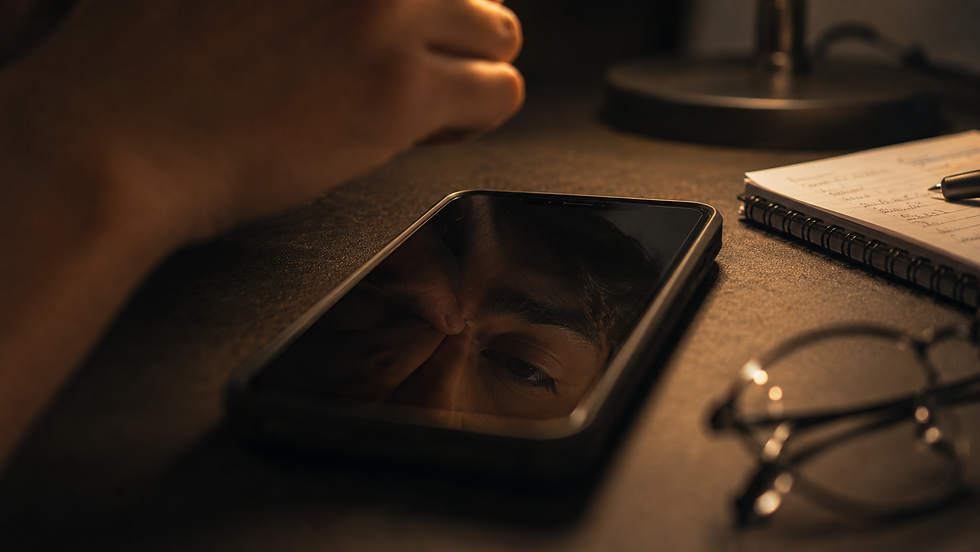
The core product can't be demonstrated on the medium doing the demonstrating. How a frame actually sits on a specific face, whether the nose pads dig in after six hours, how the temple arms feel behind the ears by evening, none of that translates through a screen, no matter how good the video production is.
The buyer this industry is growing fastest with is being told to spend less time exactly where digital ads live. Reaching parents of myopic children through more screen-based advertising sits at odds with the same public health guidance those parents are increasingly hearing directly from their child's doctor.
Virtual try-on technology has genuinely improved, and still hasn't solved the core problem. AR try-on tools help narrow down style choices, but they don't replicate weight, grip, or how a frame actually feels after real wear, which is exactly the information that decides whether a buyer keeps a pair or returns it.
Counterfeit and uncertified sunglasses listings compete directly in the same search results and marketplace feeds as genuine UV400 products. A buyer comparing options by price and star rating alone has no reliable way to tell a properly certified pair from a dark-tinted lookalike sold at a third of the price.
Prescription accuracy anxiety is a real, largely unaddressed trust gap for online-first buyers. Ordering prescription glasses without an in-person fitting still makes a meaningful share of buyers nervous enough to default to a physical store for anything beyond a second or third pair, no matter how convenient the online checkout is.
Where traditional advertising fails in a slightly different way

A hoarding has the exact same demonstration problem as a screen, just bigger and more expensive. It can show a model wearing a frame. It cannot show how that frame will sit on the buyer's own face, which is the actual purchase decision.
Print and outdoor formats can't reach the moment eye strain actually happens. The instant a buyer rubs their eyes after a long stretch at a laptop, or squints walking out into bright sunlight without sunglasses, is precisely when this category's pitch is most true, and no static format is present at that exact moment.
Retail optical store signage reaches people who've already decided to walk in. It does very little for the much larger group of people who haven't yet connected their own headaches, squinting, or blurry evenings to needing an eye test in the first place.
What this actually looks like for a brand manager to picture

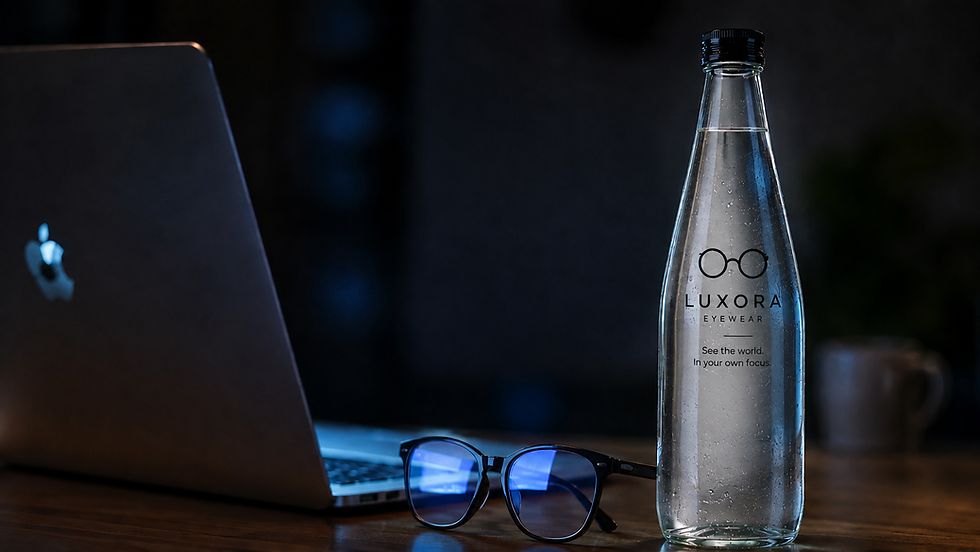
A software engineer finishes a nine hour stretch at his laptop, eyes tired, a dull headache building behind his temples the way it does most weekdays now. He reaches for water at his desk, and the bottle carries a local optical chain's name and a small line about same day eye tests. He's been meaning to get his eyes checked for months. He books the appointment before lunch, not because an ad convinced him, but because the reminder showed up at the exact moment his own eyes were already telling him something was wrong.
A father takes his daughter to the park for the two hours of outdoor time her paediatrician recommended after her last check up flagged early myopia. He picks up a bottle from a bench, and it carries a kids' eyewear brand's name, right there in the one place the doctor's own advice sent him. The message doesn't fight the guideline. It shows up inside it.
A woman leaving a Sunday morning run reaches for water at the edge of the park, sun already high and bright. The bottle in her hand carries a sunglasses brand's name and a small UV400 label. She'd been meaning to replace her old, scratched pair for weeks. She adds it to her list before she's even left the park.
None of these moments involved a click. They involved a bottle showing up exactly where eye strain, outdoor guidance, and sun exposure were already happening, not where an algorithm guessed they might be paying attention.
Matching the placement to the actual eyewear buyer

Screen heavy young professionals and students, this category's biggest volume segment for prescription glasses and blue light lenses, are genuinely well reached through co working spaces, campuses, and the cafes around both. Parents of children flagged for early myopia are best reached in parks and family community spaces, which has the added benefit of showing up exactly where the AIOS guidelines are already sending them. Sunglasses and UV protection buyers are naturally found in gyms, running clubs, and outdoor sports spaces, since that's precisely where unprotected UV exposure is actually happening in real time. Older adults managing presbyopia and reading glasses respond better to placements near community centres and neighbourhood parks than any youth-skewing digital or lifestyle placement ever could.
Side by side
Digital advertising | Traditional advertising | Hydrobillboard | |
Can demonstrate actual fit and comfort | No, a screen can't replicate weight or grip | No | Indirect, but real world presence and content build the credibility a screen can't |
Reaches the buyer at the actual moment of eye strain or sun exposure | No | No | Yes, placements sit in the exact daily moments, screen fatigue, outdoor time, sun exposure, this category is built around |
Aligns with public health guidance rather than working against it | Weak, more screen time is the opposite of what doctors are recommending for the fastest growing buyer segment | Neutral | Strong, outdoor, real world placement supports the same behaviour ophthalmologists are already encouraging |
Cost | Rising, and prescription accuracy anxiety still pushes many buyers back to physical stores anyway | 1.5 lakh to 8 lakh rupees plus a month for a decent metro hoarding | 9,999 rupees for a 25 bottle pilot, full campaigns starts from roughly 15,000 to 50,000 rupees |
Stands apart from uncertified or counterfeit competition | Weak, price sorted listings blur genuine and fake products together | Weak | Stronger, verifiable geotagged presence is something a counterfeit seller has no reason to invest in |
The quiet advantage
An industry built on vision keeps trying to reach people through the exact screens straining that vision in the first place. The brands that step outside that loop, showing up in parks, at gyms, in the real daylight moments this category actually lives in, aren't just advertising differently. They're behaving consistently with the advice their own industry's doctors are already giving.
A few honest questions
Why are eye doctors in India recommending less screen time as myopia rises? The All India Ophthalmological Society's 2026 national guidelines link excessive near screen work to worsening myopia progression in children, and recommend at least two hours of daily outdoor time along with the twenty twenty twenty rule to reduce eye strain and slow that progression.
What does UV400 actually mean, and why does it matter more than a dark tint? UV400 means a lens blocks essentially all UVA and UVB radiation up to that wavelength, while a simple dark tint alone provides no real protection and can actually increase UV exposure by causing the pupil to dilate more in low light conditions.
Is India's rising myopia rate actually linked to screen time, or is that overstated? Ophthalmologists across major Indian hospitals consistently link increased near screen work and reduced outdoor time to accelerated myopia progression in children, which is why the 2026 national guidelines specifically target both screen habits and outdoor exposure together.
Does ambient media make sense for an industry this dependent on physical fit and try on? Especially so, since the core limitation of both digital and traditional advertising here is the same, an inability to demonstrate fit or comfort, and real world presence works around that limitation rather than trying to solve it through better video production.


