Perfume and Fragrance Advertising in India

Quick answer, fragrance and perfume advertising in India is built almost entirely around a category that cannot be advertised in the way every other product can, shown and proven on a screen. Digital and traditional advertising can only ever gesture at a fragrance, a bottle photograph, a mood, a celebrity face, never the thing itself. What actually moves a fragrance buyer is proximity, a real bottle, in a real hand, in a real moment, which is exactly the terrain Hydrobillboard operates in.
A market built on heritage that's now moving very fast
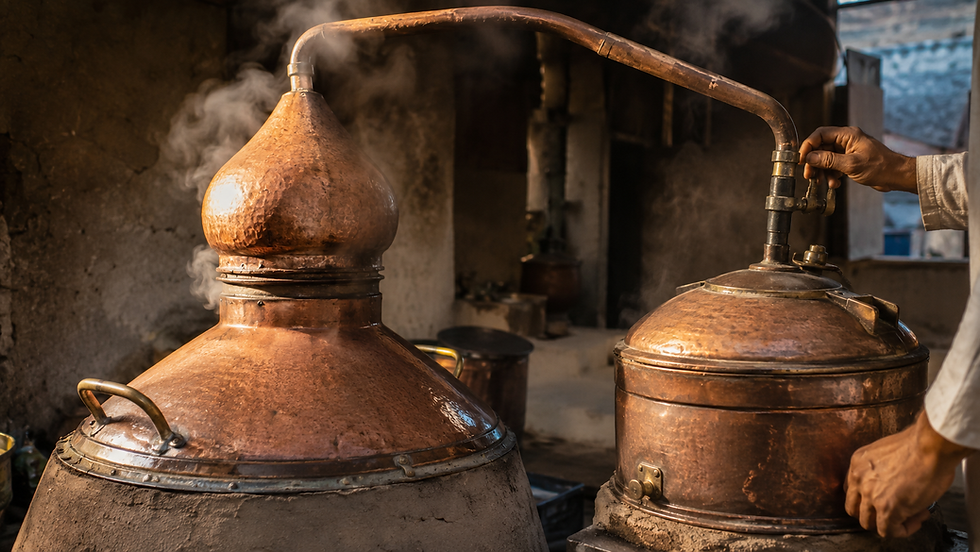
India's relationship with scent didn't start with a French perfume house. It started, centuries ago, in Kannauj, a small city in Uttar Pradesh still known today as the perfume capital of India, where traditional ittar makers distil flowers, wood, and earth into fragrance using methods barely changed since the Mughal era. That heritage industry, attar and ittar together, is now estimated at somewhere between 8,000 and 10,000 crore rupees, growing at a striking 15% to 18% a year, outperforming a lot of the modern, alcohol-based perfume categories that get far more marketing attention.
Layer the broader fragrance market on top of that, valued at roughly 1.25 billion dollars in 2025 and projected to approach 2 billion dollars by 2034, and a genuinely interesting picture emerges. This isn't a market being introduced to fragrance for the first time. It's a market with one of the oldest fragrance traditions on earth, currently being reshaped by a wave of new D2C brands, online retail, and a much younger buyer who treats scent as identity rather than occasion wear.
Online sales are expected to account for roughly 30% of total fragrance sales in India by the end of 2026, and that share is growing roughly three times faster than offline sales. New brands have moved fast into that gap. The Man Company, a men's grooming and fragrance D2C brand, reported around 20.3 million dollars in revenue in 2025, more than 70% of it online. AdilQadri, a modern attar brand that gained real momentum after a Shark Tank India appearance, grew revenue one and a half times since 2024 to roughly 22 million dollars, while also opening 40 physical stores, proof that even a digitally native fragrance brand eventually needs a place a customer can actually smell before they buy.
Every corner of this industry, not just the ones with celebrity ambassadors

It's worth naming the full range, because fragrance advertising conversations tend to default to luxury houses and skip everyone actually building the category on the ground.
International luxury and designer houses, sold through premium retail and department store counters, competing on heritage and image as much as scent itself. Homegrown premium D2C brands, built specifically around India's climate, skin, and cultural preferences rather than repackaging Western formulations.
Modern attar brands, blending centuries old ittar craft with contemporary branding and packaging for a buyer who wants tradition without it looking dated. Mass market deodorant and body spray brands, the highest volume, lowest consideration end of the category, sold almost entirely on price and availability. Independent and artisanal perfumers, a small but growing scene of people building fragrances the way craft breweries built beer, in small batches, with real formulation stories behind them.
Home fragrance and candle brands, riding the same growth wave from an adjacent angle. And gifting focused brands specifically, since a huge share of Indian fragrance purchases happen not for the buyer's own use at all, but for someone else, during festivals, weddings, and the gift giving seasons woven through the Indian calendar.
Every one of these groups is fighting the exact same core problem, in different price brackets. How do you sell something nobody can experience until it's already in front of them.
The trust gap for fragrance advertising in india that nobody's built a strong enough answer for yet

Two very different trust problems sit inside this industry, and it's worth telling them apart clearly.
The first is straightforward counterfeiting, fake designer perfumes sold as genuine, a well documented, persistent problem across Indian retail that undermines buyer confidence in premium and luxury fragrance specifically. The second is something else entirely, and far more culturally accepted, dupe fragrances, openly marketed alternatives inspired by a famous scent, sold honestly as an affordable version rather than passed off as the real thing. Dupe culture has become a genuine, respected part of how younger Indian buyers discover fragrance, not a shameful workaround, and any brand strategy that treats all fragrance imitation as the same problem is missing an important distinction.
There's a quieter regulatory story developing too, one most fragrance marketing in India hasn't caught up with yet. Globally, fragrance allergen labelling is tightening fast, the EU's expanded rules require disclosure of a much longer list of fragrance allergens, growing to 81 substances by August 2026, on any product sold there, and the International Fragrance Association's own safety standards are revised and reissued regularly to keep pace with new research. India doesn't yet have an equivalent mandatory allergen disclosure law of its own, which means genuinely careful, IFRA compliant formulation is currently a voluntary differentiator here rather than a legal requirement, the kind of quiet, hard to market credential that matters enormously to a small, increasingly sophisticated segment of buyers and barely registers with everyone else.
Where digital advertising runs into a wall that isn't going away

The core problem isn't that a screen does a bad job of representing fragrance, it's that it does no job at all. A skincare ad can at least show texture. A headphone ad, even muted, can be unmuted. A fragrance ad is a photograph of a bottle and a feeling the brand hopes the buyer associates with it, nothing more, no matter how much production value goes into the campaign.
Even a perfect representation would still be unreliable, because scent changes on every individual body. An influencer's glowing review of how a fragrance smells on them carries real limits, since the same fragrance can smell noticeably different on another person entirely, a nuance almost no digital campaign acknowledges honestly.
Algorithmic content rewards the aesthetic of the bottle over honest description of the scent. Visually striking packaging photographs and moody campaign videos perform well in a feed built around visual attention, which quietly pushes brands to invest more in how a bottle looks than in helping a buyer actually understand what's inside it.
High return and dissatisfaction rates are a real, under discussed cost of blind online buying. A fragrance bought sight unseen, or rather scent unsmelled, based on a description and a handful of reviews carries a real risk of disappointing the buyer once it's actually on their skin, a cost that doesn't show up cleanly in most digital marketing performance metrics.
Where traditional advertising has the same wall, just bigger

A hoarding has never once conveyed a scent, and it never will. The category's most expensive traditional format is, structurally, no more capable of solving the core problem than a phone screen.
In store perfume counters remain genuinely effective, and almost nothing else in traditional advertising supports them. The counter itself works because a customer can actually smell the product. Everything else, the print ad, the mall banner, the celebrity billboard, exists purely to get someone to the counter, and does nothing once they're standing there.
Festive and gifting season advertising floods the same narrow window everyone else is also fighting for. A huge share of fragrance marketing budget concentrates into a few gift heavy weeks a year, competing loudly for a buyer who's shopping for someone else and has very little time to actually evaluate the scent they're about to gift.
What this actually looks like, close up

A woman catches a trace of sandalwood while walking past a market stall, and it's gone before she can place it, but it stays with her for the rest of the day, half a memory of her grandmother's puja room. That evening she picks up a bottle at home, and it carries a Kannauj based attar house's name and a small note, "sandalwood and rose, distilled the traditional way." She orders a sample the same night, chasing the feeling as much as the scent.
A young professional notices by mid afternoon that his cologne from the morning has faded to almost nothing. He reaches for water at his desk, and the bottle carries a D2C fragrance brand's name alongside a small line about their pocket sized, long lasting eau de parfum. He's been meaning to find something that actually lasts through a full work day. He adds it to his cart before he's finished the glass.
A man shopping for a Diwali gift for his father, uncertain and mildly anxious about picking a scent he's never smelled and can't take home to test, sees a familiar brand's name on a bottle at a friend's house days earlier and remembers it clearly when he's standing in the gifting aisle, uncertain, needing exactly one confident decision to make in a store full of unfamiliar bottles.
None of these moments involved smelling an ad. They involved a name showing up at the exact moment memory, need, or decision fatigue made that name worth reaching for.
The one advantage no other product in this series has, glass answering glass

Every category covered elsewhere in this series has to work a little to justify why a glass bottle is the right medium for its message. Fragrance doesn't. A perfume brand's actual product already lives inside glass, cut, weighted, considered glass, chosen specifically because a heavy, well made bottle is part of how a fragrance communicates luxury before the cap even comes off. Nobody launches a premium scent in a flimsy plastic container. The bottle itself is doing brand work from the moment it's designed.
Which means a Hydrobillboard placement isn't an approximation for a fragrance brand the way it might be for another category. It's the same material language the brand already speaks, just handed to someone in a completely different moment of their day. The bottle doesn't need to carry scent to do its job here. It only needs to carry weight, the actual, physical weight of real glass in someone's hand, the same sensory cue a buyer already associates with opening a genuine bottle of perfume rather than a cheap imitation.
That feeling, solid, cool, considered, is doing real brand work on its own, entirely independent of whether the person holding it can smell anything at all.
And because it's water, an ordinary, unremarkable, daily act, that same feeling shows up again and again. Someone doesn't drink water from a branded bottle once. They drink from it through a workday, at a gym, on a commute, dozens of small unremarkable moments where a brand's name sits in their hand on exactly the material that brand has spent real money making feel premium in the first place. That's not a single impression.
It's a slow, repeated, physical reminder, built from the one material a fragrance brand already trusts to say luxury without saying a word.
Matching the placement to the actual fragrance buyer

Premium and luxury fragrance buyers are genuinely well reached through upscale cafés, co working spaces, and premium gyms, spaces that already skew toward the income bracket and self presentation habits this buyer already has.
Younger D2C and Gen Z focused fragrance brands do well on and around college campuses and the cafés nearby, where fragrance functions as identity and social signalling as much as personal care. Attar and heritage brands are naturally suited to placements near religious spaces, community centres, and the wedding and festival adjacent venues where traditional scent already carries deep cultural meaning. Gifting focused campaigns perform best when timed and placed around the specific festival or wedding season driving that purchase, in markets and malls during the exact weeks gifting decisions are actually being made.
Side by side
Digital advertising | Traditional advertising | Hydrobillboard | |
Can convey the actual product (scent) | No, under any circumstance, on any device | No, a hoarding can't carry scent either | Indirect, but real world presence and genuine proximity build the trust a screen structurally cannot |
Accounts for how scent varies by individual body chemistry | No, campaigns present one fixed representation | No | Not directly, but doesn't overpromise a fixed experience the way a polished ad does |
Reaches the buyer at a real moment of memory or need | Rarely, depends entirely on algorithmic timing | No | Yes, presence in daily life creates the same kind of trigger a real scent memory does |
Cost | Rising, with real return and dissatisfaction costs from blind online buying | 1.5 lakh to 8 lakh rupees plus a month for a decent metro hoarding | 9,999 rupees for a 25 bottle pilot, full campaigns starts from roughly 15,000 to 50,000 rupees |
Supports gifting decisions made under time pressure | Weak, a feed ad rarely resurfaces at the exact moment someone's standing in a gifting aisle | Weak | Strong, familiarity built over weeks resurfaces naturally at the point of decision |
The honest version of this
Nobody is going to solve the fundamental problem here, a screen will never carry a scent, and no campaign will ever guarantee a fragrance smells the same on the buyer as it did in the ad. The brands that do well in this category anyway aren't the ones fighting that limitation. They're the ones who've stopped trying to describe a scent and started making sure their name is already familiar, already trusted, already sitting quietly in someone's memory, by the time that person is finally standing close enough to actually smell it for themselves.
Frequently Asked Questions
Why can't fragrance be effectively advertised through video or social media the way most products can? Scent cannot be transmitted through any screen or digital format under any circumstance, unlike sound or visuals which can at least be technically represented, which means fragrance advertising can only ever reference the product indirectly rather than demonstrate it directly.
What's the difference between a fake perfume and a dupe fragrance in India? A fake perfume is a counterfeit product sold deceptively as a genuine branded item, while a dupe is an openly marketed, honestly labelled alternative inspired by a well known scent, a distinction that matters because dupe culture is a widely accepted, legitimate part of how many Indian buyers discover fragrance today.
Does India have mandatory fragrance allergen labelling laws like the EU? Not currently, India doesn't yet have an equivalent mandatory allergen disclosure requirement, which means IFRA compliant, carefully documented formulation remains a voluntary credential for Indian fragrance brands rather than a legal obligation, unlike the EU's expanding allergen labelling rules taking fuller effect by August 2026.
Does ambient media make sense for a product this dependent on smelling it in person? Especially so, since the core limitation shared by digital and traditional advertising alike, an inability to convey scent at all, is exactly what genuine, repeated, real world presence is positioned to work around by building familiarity long before the actual moment someone can smell the product for themselves.