
What Is Hydrobillboard — The Future of Brand Presence Through Utility Based Marketing
- Hydrobillboard Editorial

- 5 days ago
- 23 min read
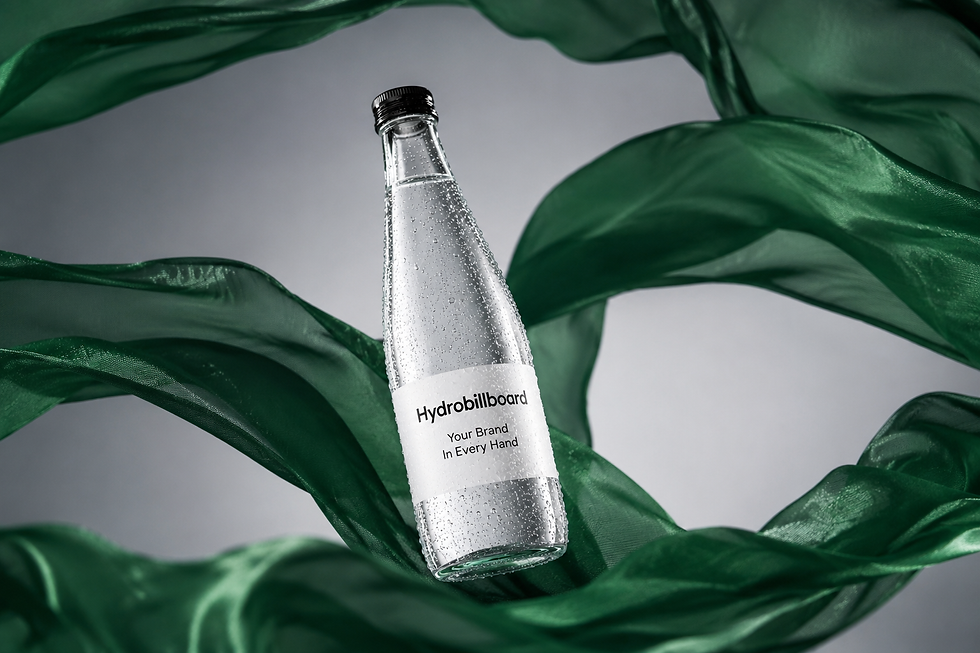
If you have arrived at this page asking that exact question — what is Hydrobillboard — you are in exactly the right place.
Hydrobillboard is a premium sustainable brand marketing platform built on a single belief: that the most powerful place a brand can exist is not on a wall, a screen, or a billboard — but in someone's hands. Every single day.
But to understand what Hydrobillboard is and why it was built, it helps to understand the problem it was designed to solve. Because Hydrobillboard did not appear in isolation. It appeared as the answer to a question that every serious brand manager in India is quietly asking right now.
We have spent the last four pieces in this journal building a case that most marketers already feel but have not yet fully articulated.
Traditional outdoor advertising is failing. Digital advertising is losing the battle for human attention. Plastic is destroying the planet. And the materials we choose to build brands with communicate values that no campaign can manufacture.
If you have read those pieces, one question has been building quietly in your mind:
So what should brands actually do instead?
This piece answers that question completely — and introduces the brand built entirely around the answer.
It covers the science of why utility based marketing outperforms every traditional and digital advertising channel ever studied. It covers the consumer psychology behind why physical branded products build deeper, more lasting brand memory than any screen or surface ever could. It covers the enormous and largely untapped hyperlocal marketing opportunity sitting right in front of every Indian brand right now. And it introduces Hydrobillboard — fully, honestly, and without apology — as the brand built around every one of these principles from the very first day.
This is the most important piece we have published.
Read it carefully.
What Utility Based Marketing Actually Means — And Why It Is Not What Most Brands Think
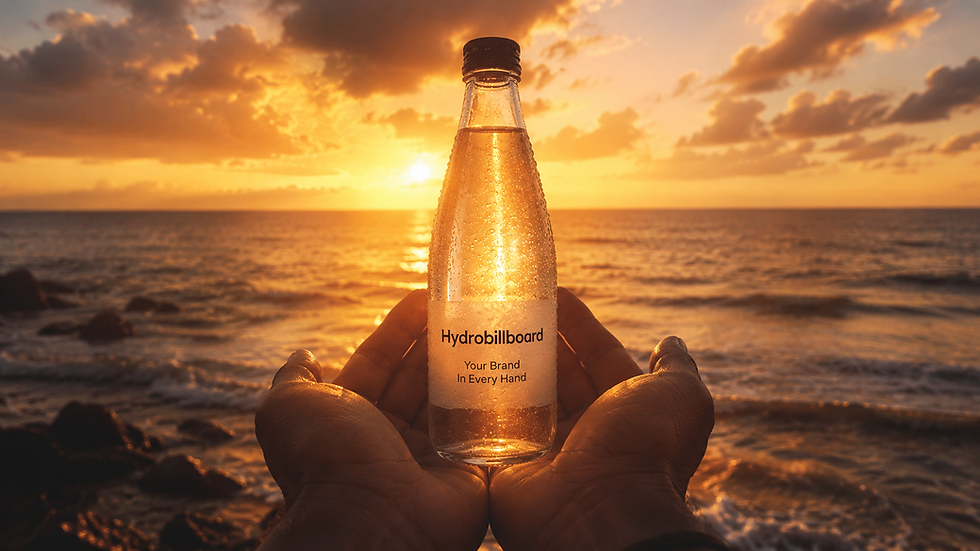
The term utility based marketing has been circulating in brand strategy conversations for several years. But it is used imprecisely so often that its actual meaning — and its actual power — gets lost in the noise.
Utility based marketing is not content marketing.
It is not giving people a free PDF or a helpful blog post.
It is not a loyalty programme or a branded app.
Utility based marketing is the practice of creating brand presence through physical objects that people genuinely use as part of their daily lives — objects that deliver real value every single day, independent of any advertising message.
The distinction is critical.
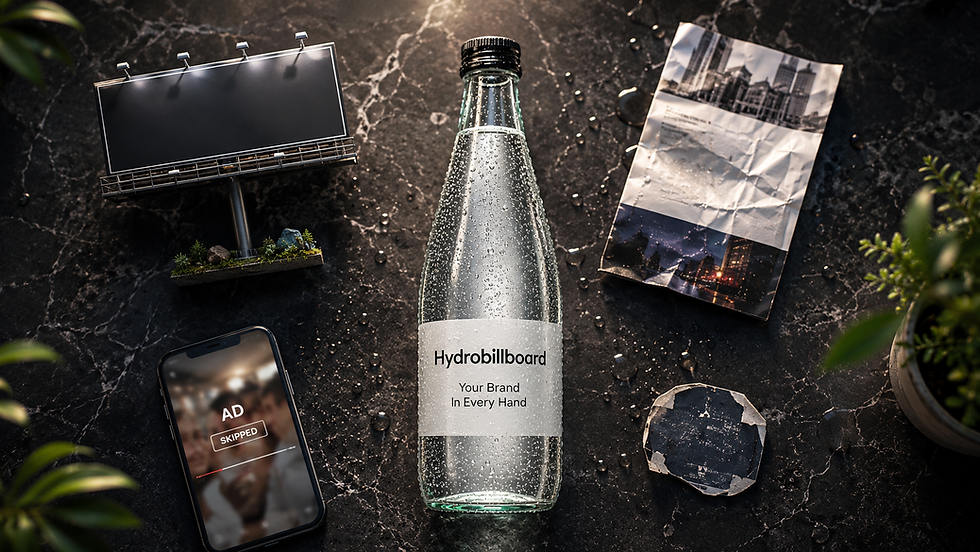
A billboard delivers a brand message. Then it stops.
A digital ad delivers an impression. Then it is skipped.
A pamphlet delivers information. Then it is thrown away.
A genuinely useful branded object — a premium water bottle, a quality bag, a beautifully designed notebook — delivers value every single time it is used. Every morning. Every commute. Every meeting. Every workout. Every day the object exists in someone's life, the brand exists with it. Not as an interruption. Not as a message. But as a presence.
That is a fundamentally different relationship between a brand and a human being. And the science behind why it works is one of the most compelling bodies of research in modern consumer psychology.
The Consumer Psychology Behind Why Branded Products Build Deeper Brand Memory Than Any Advertisement

Before we discuss numbers, it is worth understanding the psychological mechanisms that make utility based marketing work at a neurological level — because without understanding why it works, the statistics alone do not tell the full story.
The Mere Exposure Effect
First described by psychologist Robert Zajonc in 1968 and replicated in hundreds of studies since, the mere exposure effect demonstrates that people develop positive preferences for things simply by being exposed to them repeatedly over time.
Every time someone uses a branded product — picks it up, fills it, carries it, places it on a desk — they are exposed to that brand again. Not in a forced, interruptive way. Naturally. As part of a behaviour they chose to perform independently.
The brand does not need to say anything. It simply needs to be there — repeatedly, naturally, as part of the daily rhythm of someone's life. The positive association builds automatically, through the same psychological mechanism that makes people prefer a song they have heard many times over a song they are hearing for the first time.
This is why branded products with long daily-use lifespans are so disproportionately powerful compared to single-impression advertising formats.
Tactile Marketing and the Psychology of Touch
Neuromarketing research, including studies referenced by the Harvard Business Review, has consistently found that 95% of consumer purchase decisions are made subconsciously. (Source: Harvard Business Review) The physical act of touching and holding a product activates a set of neurological responses that viewing a screen simply cannot replicate.
Touch creates ownership feeling. Holding an object, even briefly, increases the perceived value a person assigns to it. This psychological phenomenon — known as the endowment effect — means that a branded object someone has held feels more valuable to them than one they have only seen in an advertisement.
Premium tactile properties — weight, texture, temperature response, material quality — communicate product and brand value through the fingertips before the conscious mind has processed a single piece of information. High-quality materials, sturdy construction, and pleasant textures convey a sense of craftsmanship and durability that justifies premium positioning in ways that no advertising copy can achieve. (Source: Fiveable Neuromarketing)
This is why a premium glass bottle feels like a luxury brand statement the moment someone picks it up — and why a plastic bottle, regardless of what it says on the label, struggles to communicate the same.
Cognitive Fluency and Brand Familiarity
Cognitive fluency is the ease with which the brain processes information. Brands that feel familiar — because they have been encountered repeatedly in natural contexts — are processed more easily, trusted more readily, and chosen more frequently than brands that feel new or unfamiliar.
A branded product that someone uses every day builds cognitive fluency with that brand at a pace and depth that no advertising campaign has ever matched. By the time a purchase decision arrives, the brand does not feel like a choice being made for the first time. It feels like the obvious continuation of something already familiar and trusted.
Emotional Brand Association Through Utility
When a product genuinely makes someone's life better — when it is beautifully designed, when it functions perfectly, when it is a pleasure to hold and use — the person using it forms an emotional association between that positive experience and the brand responsible for it.
This is emotional branding through utility. And it is the most durable form of brand loyalty that exists, because it is built on real repeated positive experience rather than on manufactured advertising emotion that evaporates the moment the campaign ends.
Neuroscience confirms that multi-sensory branding — combining touch, sight, and physical interaction — creates stronger emotional memory than single-sense advertising formats. (Source: Boston Brand Media) A person who has carried your brand's glass bottle through six months of their daily life has formed an emotional memory of your brand that no billboard, no digital ad, and no television commercial has ever created in any documented research.
The Brand Recall Science — What the Numbers Actually Say
The consumer psychology is compelling. But the research data behind branded promotional products and brand recall is where the argument becomes impossible to reasonably dispute.
The foundational statistic in this space comes from the Promotional Products Association International (PPAI) — the most comprehensive research body studying branded physical products and their marketing effectiveness:
9 out of 10 people recall a brand after receiving a promotional product from it. (Source: PPAI via SellersCommerce)
Read that number again in the context of every other advertising format you know.
Television advertising recall averages 28% in independent studies.
Digital banner advertisement recall averages between 2% and 10% depending on the study and format.
Outdoor billboard advertising produces recall rates that researchers struggle to measure consistently because the attention window is so brief — typically 2 to 3 seconds of partial attention from moving vehicles.
Branded physical products: 90% recall.
But the more remarkable finding is not the immediate recall figure. It is what happens over time.
89% of people who receive a branded promotional product can still recall the brand after two or more years. (Source: PPAI via SellersCommerce)
No advertising format in history has produced two-year recall rates approaching 89%. Not television. Not digital. Not outdoor. Not radio. Not cinema.
80% of people can recall the specific messaging of a brand from a promotional product they received. Not just the name — the message.
And perhaps the most commercially powerful finding of all: promotional drinkware — branded mugs, bottles, cups — produces 57% advertiser recall rates, compared to only 28% for television advertising. (Source: PPAI via SellersCommerce)
A branded bottle outperforms television advertising for brand recall. By a factor of more than two to one.
This is not a niche finding. This is one of the most consistent results in promotional marketing research — replicated across markets, demographics, and product categories over decades of independent study.
Additional data points that complete this picture:
73% of workers say company promotional products boost their sense of belonging and pride — creating internal brand advocacy alongside external visibility. (Source: Brandelity)
69% of people use or wear company-branded items outside of their workplace — extending brand visibility organically into social environments without any additional spend.
46% of consumers feel more favourable about brands that offer eco-friendly promotional products — a figure that rises significantly among younger and more environmentally conscious demographics. (Source: Brandelity)
43% increase in demand for sustainable promotional products reported by major distributors, with the trend accelerating sharply as sustainability becomes a mainstream brand value rather than a niche differentiator. (Source: Brandelity)
Brands require 5 to 7 impressions before a logo or name becomes familiar to a consumer. (Source: Brand Awareness Statistics) A branded product used daily delivers those impressions automatically — not through paid media spend, but through the natural rhythm of someone's life.
The data, across every credible independent source that has studied this question, points in the same direction.
Physical branded utility products are the highest-recall, most emotionally durable, and most cost-effective brand awareness tool available to any company operating anywhere in the world.
And the Indian market is sitting at the precise intersection of this insight and a demographic and economic shift that makes the opportunity larger here than almost anywhere else on earth.
Hyperlocal Marketing in India — The Largest Untapped Brand Opportunity of This Decade

India is not one market. It never has been. It is more than one billion individual markets, speaking hundreds of languages, living across climates and cultures and economic realities so diverse that no single national advertising campaign has ever genuinely captured all of them.
And that diversity — which traditional national advertising has always struggled with — is precisely what makes hyperlocal marketing the most powerful brand strategy available to Indian companies right now.
The numbers behind India's hyperlocal moment are extraordinary:
The India hyperlocal market is projected to reach USD 141.06 billion by end of 2026 — driven by smartphone penetration, digital payment infrastructure, and a rapidly expanding middle class in Tier II and Tier III cities that national brands have historically underserved. (Source: Fortune Business Insights)
India had 806 million internet users as of early 2025, with Tier II and Tier III users growing fastest — representing an enormous and underserved audience for brands that can reach them with relevant, locally resonant presence. (Source: Makreo Research)
Digital advertising spending in India reached ₹49,000 crore in the 2024-2025 fiscal year, growing at 20% year-over-year and establishing digital as the largest advertising medium in the country. (Source: Arjan KC) This tells us not that digital advertising is working — as we established in previous pieces, it is largely not — but that Indian brands are spending at a scale that makes the contrast between what they are spending and what they are achieving more commercially significant than ever.
Tier II and Tier III cities contributed 56% of e-commerce shoppers in FY 2024, forecast to reach 64% by FY 2030. (Source: Makreo Research) These are the consumers who are underrepresented in national advertising campaigns and overrepresented in the genuine growth opportunity for Indian brands over the next decade.
What Hyperlocal Marketing Actually Means for Indian Brands
In the Indian context, hyperlocal marketing is not simply location-based digital targeting. It is about creating genuine brand presence at the community level — in the offices, the universities, the hospitals, the hotels, the events, and the daily environments where real people in specific places actually spend their time.
The most powerful hyperlocal marketing is not digital. It is physical.
A branded presence in the office buildings of Bandra Kurla Complex in Mumbai reaches a specific, valuable, concentrated audience of finance and media professionals. A branded presence in the startup hubs of Koramangala in Bengaluru reaches a specific, valuable, concentrated audience of technology entrepreneurs and investors. A branded presence at the premium hotels and conference centres of Connaught Place in New Delhi reaches a specific, valuable, concentrated audience of business decision-makers from across India and internationally.
These audiences cannot be reached at the same concentration, the same emotional context, or the same brand recall depth through any digital advertising format. Because in digital, they are scrolling past your ad to get back to what they actually came for. In hyperlocal physical presence, your brand is already part of the environment they chose to be in.
India is not one market. Hyperlocal marketing treats it correctly — as thousands of distinct communities, each with its own concentration of exactly the kind of people any premium brand needs to reach.
The Luxury and Sustainability Intersection — Where the Most Valuable Brand Positioning of This Decade Lives
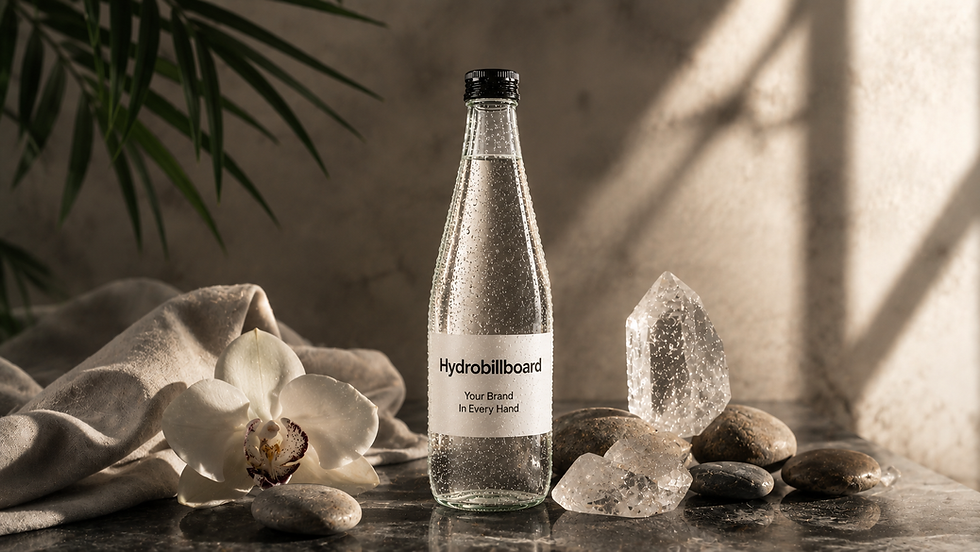
There is a belief in traditional marketing that sustainability and luxury are opposing forces. That premium positioning requires the kind of extravagance that is incompatible with environmental responsibility. That eco-friendly brands sacrifice sophistication.
That belief is not only wrong. It is increasingly commercially catastrophic for the brands still holding it.
McKinsey's 2025 research across 11 countries found that 36% of Indian consumers are willing to pay significantly more for sustainable packaging — the highest figure of any country surveyed globally. (Source: McKinsey & Company)
In a 2026 PwC Consumer Intelligence Series survey of 22,000 shoppers across 25 countries, 51% said they were willing to pay a price premium of 9.7% or more for brands they actively trusted — with premium tolerance rising to 18.3% among millennials who had engaged with a brand's transparency initiatives at least three times before purchasing. (Source: Amra and Elma)
The world's most enduring luxury brands — Aesop, Patagonia — have not succeeded despite their environmental positioning. They have succeeded partly because of it. Because their commitment to material quality, durability, and environmental responsibility is not a marketing decision. It is a design decision. A values decision. And audiences, particularly the most commercially valuable younger audiences, can tell the difference between a brand that genuinely lives its values and one that dresses its existing practices in sustainable language.
The convergence of luxury and sustainability is not a trend. It is a structural shift in what premium means — and what it will mean for every decade ahead.
The most valuable brand positioning available to any Indian company right now is this: be genuinely premium and genuinely sustainable simultaneously, with no contradiction between the two.
That positioning is what Hydrobillboard was built to occupy.
So — What Is Hydrobillboard? The Complete Answer
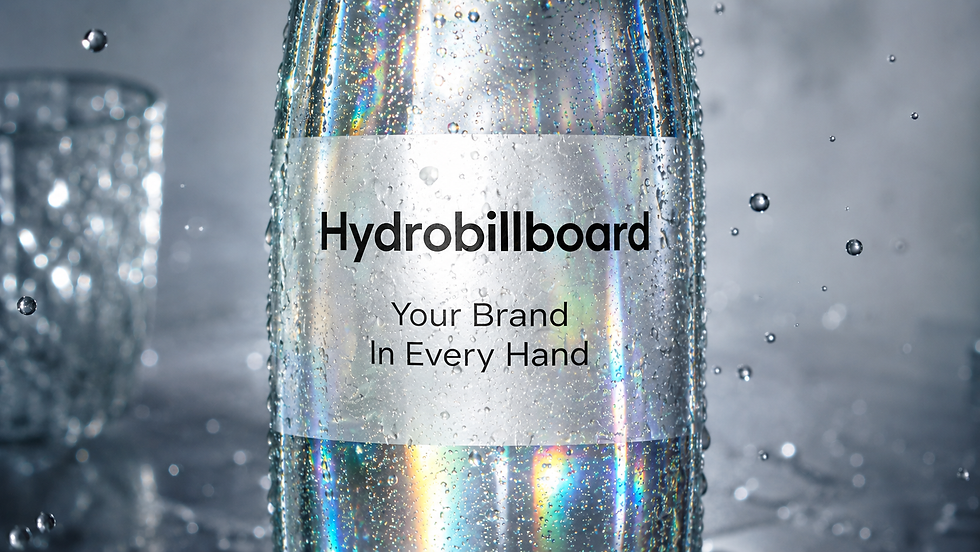
Everything we have covered — utility based marketing, brand recall science, tactile psychology, hyperlocal marketing, luxury sustainability — was not assembled as a post-hoc justification for a product that already existed.
It is the foundation on which Hydrobillboard was conceived, designed, and built from the very first day.
Hydrobillboard is a premium sustainable brand marketing platform that puts your brand in people's hands — literally — through beautifully crafted glass water bottles that carry brand identity naturally through offices, events, institutions, and the daily environments of real people.
Not a billboard they drive past in two seconds. Not a digital ad they skip in less than one. Not a pamphlet they drop in a bin before reading.
A premium object they choose to carry. Every day. For months. For years.
What Hydrobillboard Actually Is
At its most practical level, Hydrobillboard works like this:
A brand partners with Hydrobillboard. A premium glass bottle is designed and crafted to carry that brand's identity with elegance and intention. That bottle is placed — through Hydrobillboard's distribution network — into the hands of real people in real environments: offices, co-working spaces, universities, premium hotels, corporate events, hospitality venues, health and wellness centres, and the daily environments where India's most valuable consumer audiences actually spend their time.
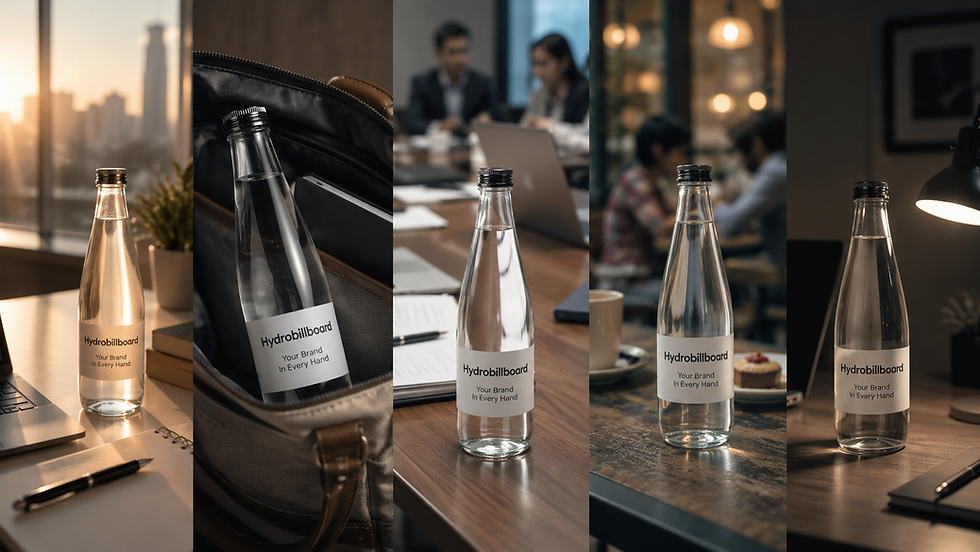
Every day that bottle is used, the brand travels with it. Into meetings. Into gyms. Into cafés. Into homes. Into the hands of everyone who sees it being carried.
The brand does not interrupt. It does not compete for attention against entertainment. It does not fight an algorithm for a moment of visibility before being scrolled past.
It simply exists — naturally, usefully, beautifully — as part of someone's daily life.
The Six Pillars of the Hydrobillboard Model
Pillar 1 — Eco Friendly Zero Waste Brand Presence
Every Hydrobillboard product is designed to be used repeatedly, indefinitely — replacing the single-use plastic bottles that collectively represent one of the most damaging and unnecessary forms of waste in the modern world.
A single plastic bottle used for twenty minutes will outlast every human being alive today. A Hydrobillboard glass bottle, carried and refilled every day, removes that plastic from existence entirely — while simultaneously carrying a brand into the world with it.
This is not sustainability as a marketing message. It is sustainability as a product function. The bottle does not say it is eco-friendly. It simply is, by its nature, design, and material.
Pillar 2 — Premium Glass Brand Presence
Glass is not a packaging material at Hydrobillboard. It is a brand statement.
As we explored in the previous piece in this journal, glass communicates weight, permanence, quality, and craft before a single word is read. It creates a tactile experience that activates the endowment effect, the premium perception bias, and the material quality association that luxury brands have relied on for generations.
A Hydrobillboard glass bottle in someone's hand says — without a single word of copy — that the brand it carries takes quality seriously. That it respects the person holding it. That it chose something worth making rather than something convenient to discard.
Pillar 3 — Hyperlocal Marketing Reach
Hydrobillboard operates through placement networks in specific, high-value environments — not through mass distribution that dilutes brand positioning.
A premium brand's bottle in a premium office environment reaches a premium audience. In a university, it reaches a young and brand-forming demographic. In a five-star hotel, it reaches decision-makers and high-net-worth individuals. In a corporate event, it reaches exactly the professional community the brand needs to be known within.
This is hyperlocal marketing at its most precise and its most valuable — concentrating brand presence in the exact physical environments where the right audience is already present, rather than broadcasting to everyone and reaching no one meaningfully.
Pillar 4 — Daily Repeated Brand Visibility
A standard outdoor advertisement gets 2 seconds of partial attention from a driver passing at speed.
A digital advertisement gets less than 1.7 seconds before being skipped.
A Hydrobillboard glass bottle, used by a professional throughout their working day, generates between 15 and 25 direct brand interactions per day. Multiple daily pick-ups. Multiple refills. Multiple moments of carrying it through shared spaces. Multiple occasions of setting it on a desk where colleagues, clients, and visitors see it at rest.
Over a year of daily use, that is more than 7,000 direct brand interactions from a single bottle — not counting the secondary visibility it generates in every shared environment it travels through.
No advertising format produces numbers like these at the cost per impression that a well-designed physical product delivers.
Pillar 5 — Consumer Trust Through Genuine Utility
There is a trust dimension to utility based marketing that advertising formats simply cannot access.
When a brand gives someone something genuinely useful — something that improves their daily experience, that functions beautifully, that they would choose to own independently — the emotional association that creates is fundamentally different from the association created by seeing an advertisement.
Advertising creates awareness. Utility creates gratitude. And gratitude, in consumer psychology, is one of the most powerful and durable drivers of brand loyalty that exists.
95% of consumer decisions are subconscious. (Source: Harvard Business Review) The subconscious associations built through months of daily positive experience with a brand's product are deeper, more stable, and more purchase-influencing than any consciously received advertising message.
Pillar 6 — No Digital Ad Spend Required
This final pillar is perhaps the most commercially significant for the brand managers and marketing decision-makers reading this.
Every rupee spent on digital advertising disappears the moment the campaign ends. There is no residual asset. No lasting presence. No compound return on the investment. When the budget stops, the impressions stop.
A Hydrobillboard product is a physical asset that continues generating brand presence, brand recall, and brand association for every day it remains in use — whether that is six months, two years, or a decade.
The return on investment compounds over time rather than evaporating at the end of a campaign cycle. The presence grows rather than requiring continuous reinvestment to maintain.
This is brand marketing that builds an asset instead of renting an audience.
But here is the dimension of this pillar that most brands do not expect when they first hear about Hydrobillboard — and the one that makes the no-ad-spend proposition genuinely complete.
When your brand partners with Hydrobillboard, your social media presence is covered too.
This is not a small addition. It is one of the most commercially significant parts of the partnership.
Here is what that means in practice:
When Hydrobillboard runs a campaign for your brand, we do not simply place a glass bottle in an environment and leave it there. We document it. We build content around it. We create campaign reels that feature your brand being carried, being used, and existing naturally in premium real-world environments — and we publish those reels across Hydrobillboard's social platforms on your behalf.
We create posts across Instagram, X, and other platforms that tell your brand's story — what your brand stands for, what it offers, and why it chose a more intentional way to show up in the world. We produce campaign videos that introduce your brand to our audience — an audience of brand-conscious, sustainability-aware, premium lifestyle consumers who are exactly the people most Indian brands spend enormous sums trying to reach through digital advertising.
What this means for your brand in practical terms:
You do not need to worry about whether your Instagram account has enough content this week.
You do not need to brief a social media agency on what to post about your campaign.
You do not need to run paid boosting on Reels to reach people who might care about your brand.
You do not need to manage an X content calendar around your marketing activity.
Hydrobillboard handles the physical presence — your glass bottle in real hands in real environments.
And Hydrobillboard handles the digital amplification of that presence — the reels, the posts, the campaign content, the brand storytelling across social platforms — turning every physical placement into a piece of content that extends the reach of your campaign into digital spaces without requiring you to spend a single additional rupee on digital advertising.
The physical and the digital working together — both covered under one partnership.
For brands that have been managing separate agencies for offline presence, social content, and digital advertising simultaneously — paying separately for each, coordinating between all three, and watching the results of each remain disconnected from the others — the Hydrobillboard model represents something genuinely different.
One partnership. One glass bottle. One cohesive brand story told across the physical environments your customers inhabit and the social platforms they scroll through.
No separate social media agency. No separate content production budget. No separate digital ad spend. No separate campaign coordination.
Just your brand — present, premium, and visible — in every hand and on every screen that matters.
This is brand marketing that builds an asset instead of renting an audience.
And it is brand marketing that tells your story in every medium simultaneously — without asking you to manage any of it alone.
The Vision: A World Where Luxury, Sustainability, and Nature Exist Together
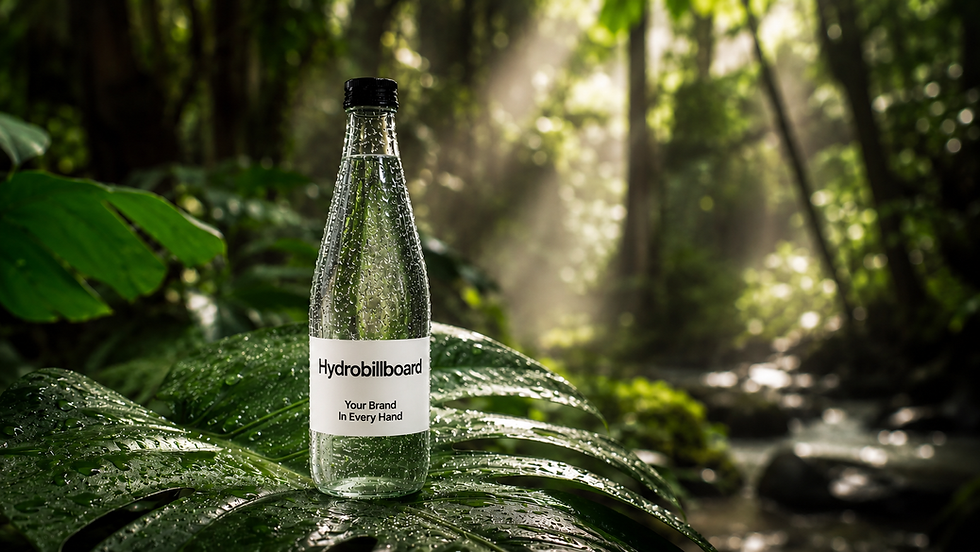
Here is the belief that sits at the absolute centre of everything Hydrobillboard was built around.
And it is worth stating it directly — without the softening qualifications that most brands use to avoid committing to what they actually believe.
We believe the world can be free of unnecessary plastic without sacrificing beauty, quality, or the experience of genuine luxury.
But that belief alone is not enough to describe what truly drives us.
Because this is not only about brand marketing.
It is not only about replacing plastic bottles with glass ones.
It is not only about helping Indian brands find a smarter way to create presence in the world.
It is about something older, quieter, and far more important than any of that.
This planet does not belong to us.
We forget that regularly.
We forget it every time we wrap something in plastic for convenience. Every time we leave a hoarding made of PVC flex rotting on a roadside for months after the campaign ended. Every time we print a million pamphlets that survive less than a day before becoming the waste that lines every Indian street corner.
We forget it.
But the animals living in this world alongside us do not have the luxury of forgetting.
They simply live with what we leave behind.
The Snow Leopard is down to fewer than 4,000 individuals in the wild globally.
The Indian Gharial — one of the most ancient reptile species on earth — teeters at fewer than 300 breeding adults.
The Great Indian Bustard, once common across the Indian subcontinent, now numbers fewer than 150 birds.
The Ganges River Dolphin — an animal that has lived in India's rivers for millions of years — is classified as endangered, its numbers collapsing alongside the rivers that are slowly becoming open drains of human waste and plastic pollution.
Across the world, scientists estimate that we are losing species at a rate between 1,000 and 10,000 times higher than the natural background extinction rate. (Source: WWF)
One million animal and plant species are currently threatened with extinction — more than at any point in human history. (Source: IPBES Global Assessment)
These are not statistics from a distant ecosystem.
A leopard was found dead in Aarey Colony in Mumbai — one of the last urban forest patches in any major Indian city — with plastic in its body.
Olive ridley sea turtles return every year to nest on Indian beaches that are increasingly covered in the plastic waste our cities send to the ocean.
Indian elephants — animals that have walked this land for millions of years — are dying in forests contaminated by the plastic waste that travels from our roads into places no human foot regularly reaches.
These animals did not vote for plastic.
They did not choose single-use packaging for convenience.
They did not decide that a campaign needed a thousand PVC flex banners that would sit on roadsides for months after the election was over.
They simply live here.
They have lived here far longer than we have.
And they are paying for choices they were never part of making.
Hydrobillboard cannot fix this.
We need to say that plainly — because false promises about environmental impact are one of the most dishonest things a brand can make.
We are a small startup.
We make premium glass bottles that carry brand identity into the world more honestly and more beautifully than plastic ever could.
We are not a conservation organisation. We are not a wildlife protection body. We are not equipped to reverse a century of industrial damage to the planet's ecosystems by ourselves.
But here is what we genuinely believe — and what drives every decision we make as a brand:
If every company that chose a single-use plastic promotional item chose a reusable glass one instead — the world would have less plastic in it.
Not zero plastic.
Not a solved crisis.
But less.
And less is where every meaningful change in history has always started.
Not at the finish line. At the beginning of a direction.
If Hydrobillboard can contribute to solving even 1% of the unnecessary plastic that flows from brand marketing and promotional activity every year in India —
1% of the PVC flex boards that never get recycled.
1% of the plastic bottles used once at corporate events and thrown into bins.
1% of the disposable promotional items manufactured for campaigns that last three days and then enter the waste stream for centuries.
That 1% is not nothing.
That 1% is real animals not finding plastic in their habitat.
That 1% is real soil not receiving another layer of microplastic contamination.
That 1% is real water bodies carrying slightly less of what does not belong in them.
That 1% is a beginning.
And every meaningful thing that has ever changed this world began as someone deciding that a beginning was worth making — even when the full solution was nowhere in sight.
We embrace nature not as a backdrop for our branding.
Not as an aesthetic for our Instagram account.
Not as a story we tell to make our product sound more premium than it is.
We embrace nature because this planet was extraordinary long before the first human being walked it — and because the leopards, the dolphins, the bustards, the elephants, the turtles, the trees, the soil, the rivers, and the ten million species we share this world with did not do anything to deserve what we have given them in return.
We are not here to save the world.
We are here to be one brand that chose to do slightly less damage.
One brand that decided a beautiful, reusable glass bottle was worth making.
One brand that believes 1% is worth fighting for — because when enough brands believe that simultaneously, 1% becomes 2%.
Then 5%.
Then something that starts to look like change.
That is the world we are trying to belong to.
And that is the world we are inviting every brand we work with to belong to also.
A world where premium and responsible are the same word.
A world where the animals still have somewhere clean to live.
A world where the rivers carry water instead of plastic.
A world where a glass bottle in someone's hand is not just a brand decision —
It is a small, quiet, daily act of choosing to be part of something better than what came before.
One bottle. One brand. One percent.
That is where we start.
Why Hydrobillboard Arrives at Exactly the Right Moment
The convergence of forces that makes Hydrobillboard's positioning powerful is not accidental. It reflects a genuine and measurable shift in the consumer, environmental, and commercial landscape that has been building for years and has now arrived at a tipping point.
Digital advertising in India is spending ₹49,000 crore per year with declining effectiveness, rising ad blocker adoption, and increasing consumer immunity to digital interruption.
Traditional outdoor advertising is losing emotional resonance as cities become visually saturated and audiences develop reflexive ignore patterns toward hoarding-scale communication.
Plastic waste from single-use advertising materials — PVC flex boards, synthetic banners, disposable campaign structures — is contributing to an environmental crisis that consumers, regulators, and forward-thinking brands are increasingly unwilling to ignore.
The Indian consumer's willingness to pay a premium for sustainable, quality products is higher than any other country measured in McKinsey's most recent global research.
Branded physical products produce 90% brand recall at two years — compared to 28% for television and low single digits for digital advertising.
The hyperlocal marketing opportunity in India — reaching specific, high-value, concentrated audiences in premium physical environments — is largely unoccupied by any brand operating at the premium end of the market.
Every one of these forces points in the same direction.
Toward a model where brand presence is physical, premium, sustainable, and genuinely useful.
Toward an approach where the object carrying a brand is worth keeping rather than designed for disposal.
Toward the understanding that the most powerful advertisement a brand will ever run is the one that lives in someone's hands — every day, for years — rather than the one that disappears from a screen in less than two seconds.
That is Hydrobillboard.
Who Hydrobillboard Is Built For
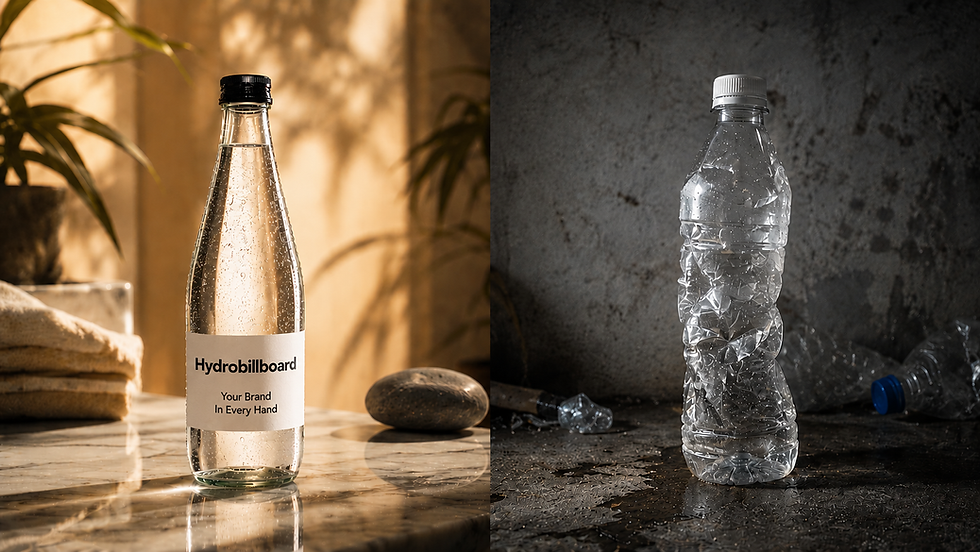
Hydrobillboard is not for every brand. And it is worth being honest about that, because the brands it is built for are specific.
Hydrobillboard is for brands that:
Understand that quality of brand presence matters more than quantity of impressions
Are ready to associate their identity with premium materials, genuine sustainability, and considered design
Want to reach specific, high-value audiences in the physical environments those audiences actually inhabit
Are looking for marketing investments that build lasting brand assets rather than renting temporary attention
Believe that how they show up in the world reflects who they are as a company
Are done watching advertising budgets disappear into digital channels and produce results they cannot honestly defend
Hydrobillboard is for the brand that is ready to be held.
Not seen from a distance. Not scrolled past. Not blocked.
Held. Carried. Used. Trusted. Remembered.
The Numbers That Make the Case
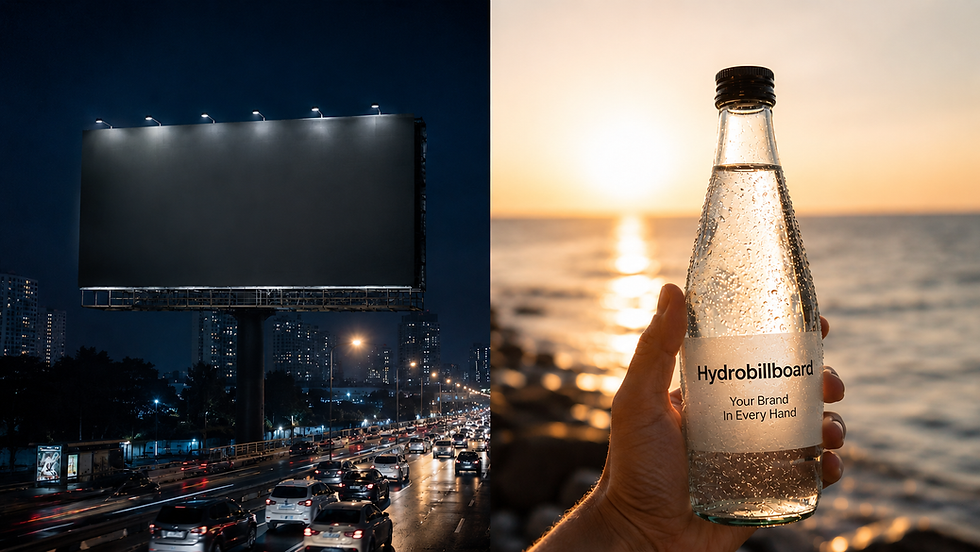
For the decision-makers reading this who need to translate vision into commercial justification, here is the summary of what the research establishes:
Advertising Format | Brand Recall Rate | Duration of Recall |
Digital banner advertising | 2% to 10% | Hours to days |
Television advertising | 28% | Days to weeks |
Outdoor billboard | Unmeasurable consistently | Seconds |
Branded physical drinkware | 57% to 90% | Months to years |
Metric | Digital Advertising | Hydrobillboard |
Daily brand interactions per placement | 1 to 3 impressions | 15 to 25 interactions |
Recall after 2 years | Near zero | 89% |
Consumer trust association | Interruptive — neutral to negative | Useful — positive |
Environmental impact | Contributes to digital waste and energy consumption | Replaces single-use plastic |
Residual asset after campaign ends | Zero | Physical product continues generating presence |
The commercial argument for utility based marketing over traditional and digital advertising formats is not close. It is not ambiguous. And it is supported by decades of independent research across every major marketing study body that has examined the question.
The Bottom Line

We started this journal by establishing that traditional advertising was failing.
We established that digital advertising was losing the battle for human attention.
We established that glass communicates premium and sustainable values that plastic never can.
We established that plastic pollution has reached a crisis point that demands a response from every brand making material choices.
We established that one million species are threatened with extinction — and that the animals sharing this planet with us are paying for choices they were never part of making.
And now we establish the conclusion that all of those pieces were building toward:
The future of brand presence does not live on walls, poles, screens, or any surface that people walk past, scroll past, or actively avoid.
It lives in something people choose to hold.
Something worth making. Something worth carrying. Something worth keeping.
Utility based marketing is not a trend. It is the correction of a decades-long mistake — the mistake of believing that interrupting people is the same as connecting with them.
Hydrobillboard is not just a product.
It is the physical embodiment of a different belief about what advertising should be — and what it can become when brands are willing to hold themselves to the standard of making something genuinely worth existing in the world.
A world without unnecessary plastic. A world where the animals still have somewhere clean to live. A world where luxury and sustainability are the same thing. A world where your brand lives in every hand.
That is the world we are building.
One bottle. One brand. One percent.
That is where it starts.


